The same thread, every few months
There's a thread that resurfaces on r/cybersecurity regularly. The title changes, but the complaint doesn't:
"Drata and Vanta didn't meet my needs. Looking for a more secure and affordable alternative."
The responses follow a familiar pattern. Someone recommends Sprinto. Someone mentions Thoropass. A few people pitch their own product. And buried in the comments, one person says something that nobody addresses:
"Most compliance platforms aren't really security tools — they're documentation and process management systems."
That's the conversation the GRC industry doesn't want to have. So let's have it.
The checkbox problem isn't a bug — it's the product
Drata, Vanta, Secureframe, Sprinto — they do roughly the same thing. They connect to your cloud environment, pull configuration data, map it to SOC 2 or ISO 27001 controls, and generate evidence artifacts for your auditor.
This is genuinely useful. It replaced the era of screenshots and shared drives. Nobody should go back to that.
But here's what these platforms don't do:
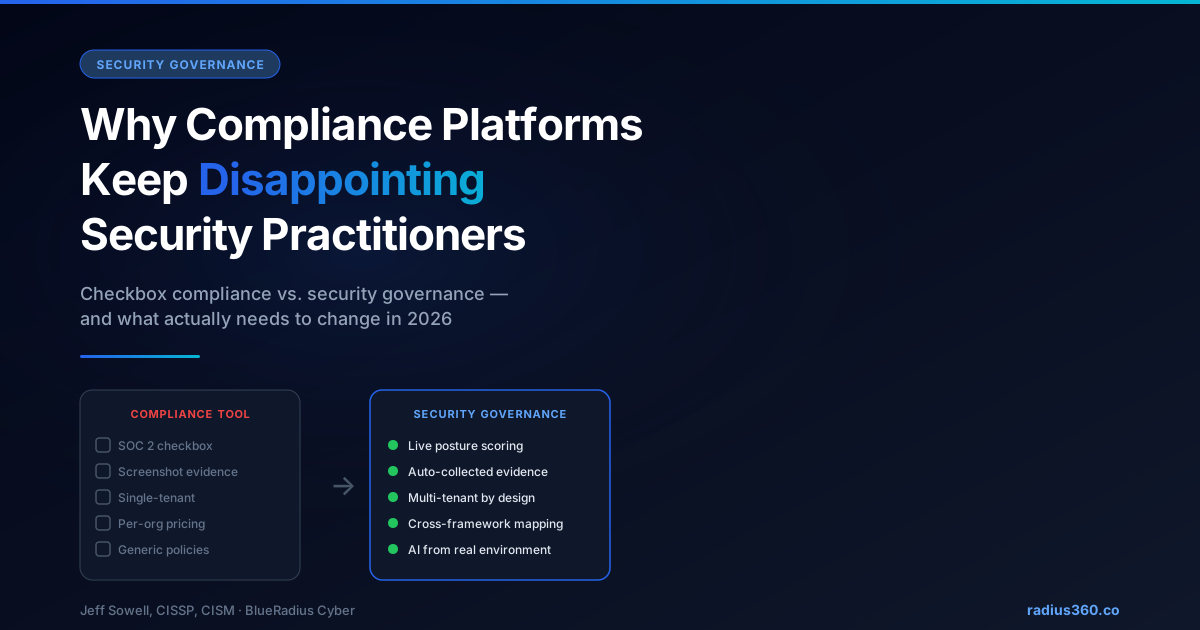
- They don't tell you whether your security program is actually working
- They don't help you make risk decisions
- They don't generate policies that reflect your real environment
- They don't give your board a posture answer that means anything
- They don't scale across multiple clients without per-seat cost explosions
They automate compliance documentation. They don't automate compliance thinking.
The distinction matters because a SOC 2 badge doesn't mean you're secure. It means you documented that certain controls exist. Whether those controls are effective, proportionate, or actually reducing risk — that's a different question entirely. And it's the question your board, your clients, and your cyber insurance carrier are actually asking.
What practitioners are really looking for
When someone posts "I need a Drata/Vanta alternative," they're rarely looking for a cheaper version of the same thing. Read the threads carefully and the actual pain points cluster around five themes.
1. Security signal, not just compliance artifacts
Practitioners want a platform that synthesizes what their security stack is detecting — not just whether a checkbox is green. When your XDR flags lateral movement, that should become a risk in your register, mapped to controls, with a mitigation task assigned. Not a Slack notification that someone manually translates into a spreadsheet row.
This is the difference between evidence collection and security intelligence. Compliance platforms do the first. Security governance requires the second. The platforms that connect your integrations to your risk register — automatically mapping findings to framework controls — solve a fundamentally different problem than screenshot collectors.
2. Framework overlap that stops wasting your time
Most organizations today need SOC 2 and ISO 27001 and NIST CSF and maybe HIPAA or CMMC depending on their vertical. These frameworks share 40-60% of their controls. But every compliance platform treats them as separate programs.
You end up maintaining parallel evidence, parallel assessments, parallel timelines — for controls that are fundamentally the same requirement expressed in different language.
Cross-framework control mapping isn't a feature. It's architecture. Map a control once, satisfy three frameworks. That's not a nice-to-have — it's the difference between your second framework costing 30% more or 300% more. We wrote about this in detail in our cost of compliance analysis.
3. Multi-client economics that don't penalize scale
This is where the conversation diverges sharply between internal security teams and practitioners who manage multiple clients — vCISOs, consultants, and MSSPs.
Drata and Vanta price per organization. If you manage 8 clients, you pay for 8 instances. The per-seat model compounds from there. A vCISO managing a reasonable book of business can easily spend more on compliance tooling than they charge for an individual client engagement.
The practitioners posting on Reddit aren't looking for a cheaper seat. They're looking for a platform designed from the ground up for multi-tenancy — where adding a client is a configuration change, not a new contract. For context on how this affects practice economics, the per-client platform cost difference between single-tenant and multi-tenant architectures is often 90% or more.
4. AI that does useful work, not marketing demos
Every GRC platform now claims AI features. Most are a thin wrapper around a language model that generates generic policy text. The output reads like it was written for a different company — because it was. It's a template with your company name injected.
Useful AI in a GRC context means something specific: risk scoring informed by your actual integrations, policy generation that cites your evidence and control gaps, gap assessments that understand what you've already implemented, and questionnaire responses that pull from your real posture data. The AI should know your environment, not just your framework.
5. Board-ready output on demand
The final frustration practitioners express — usually indirectly — is the reporting gap. They can show an auditor that controls are in place. They cannot show a board that the security program is healthy, improving, and worth the investment.
A compliance platform generates audit evidence. A security governance platform generates executive confidence. The difference is whether the CEO can open a single page and know, without calling you, where the program stands. Not "we passed SOC 2." That's binary. "Our posture is 72, up from 58 last quarter, with two critical risks pending mitigation and evidence collection running automatically from 46 integrations." That's a governance answer.
The real divide: documentation vs. governance
The compliance automation market solved a real problem circa 2020: getting SOC 2 was too manual. Drata and Vanta deserve credit for making that process dramatically more efficient.
But the market has moved. The question practitioners are asking in 2026 isn't "how do I get SOC 2?" It's:
- How do I manage 20 clients across 5 frameworks without drowning in administrative overhead?
- How do I prove to a board that our security program is improving, not just that we passed an audit?
- How do I get my integrations to feed my risk register automatically instead of hiring someone to translate alerts into spreadsheet rows?
- How do I onboard a new client in hours instead of weeks?
These are governance questions, not compliance questions. And the platforms built to answer checkbox questions aren't going to evolve into governance platforms — because the architecture is different. Multi-tenancy, cross-framework mapping, deep integration pipelines, and AI that learns from your environment aren't features you bolt onto a single-tenant compliance tool. They're foundational decisions.
What this means for practitioners evaluating platforms
If you're a vCISO, MSSP, or security leader looking at GRC platforms right now, here's what I'd recommend based on building and evaluating these tools for the past several years:
Ask about architecture, not features. Is the platform multi-tenant by design, or is multi-tenancy simulated through workspaces? Does cross-framework mapping happen at the control level, or is it a post-hoc report? These architectural decisions determine what's possible — and what will always be a workaround.
Test the AI with your own data. Generate a policy. If it reads like something from a template library with your name swapped in, the AI isn't using your environment data. If it references your specific control gaps, integration findings, and risk posture — that's real.
Calculate the per-client cost. Not the sticker price — the actual cost per client in your practice. Include seats, per-org fees, and the labor hours required to maintain separate instances. Then compare that to a multi-tenant platform where all clients live under one subscription.
Ask for a board report. Not an audit report — a board report. If the platform can't generate a one-page executive summary of posture, risk trajectory, and compliance status in under 60 seconds, it's an auditor tool, not a governance tool.
The bottom line
Drata and Vanta solved the compliance documentation problem. That was the right problem for 2020. In 2026, security practitioners need governance — the ability to stand up, maintain, and demonstrate a security program that actually works, across multiple frameworks, multiple clients, and multiple stakeholders who all want different answers to the same question: are we secure?
The platforms that win this market won't be the ones with the most integrations or the cheapest seat. They'll be the ones that close the gap between what your security tools detect and what your board needs to hear — automatically, continuously, and without requiring a four-hour scramble every time someone asks.
Jeff Sowell is the founder of BlueRadius and the builder behind Radius360, a GRC platform designed for vCISOs and MSSPs managing multiple client security programs. He holds CISSP, CISM, and CASP+ certifications and has spent 15+ years building security programs for organizations across defense, healthcare, and financial services.
If you're evaluating GRC platforms and want to see the difference between compliance automation and security governance, try Radius360 free for 7 days — no credit card required.
See how Radius360 helps
Put these ideas into practice with the right tooling.
Compare GRC Platforms for vCISOs