Why This Report Exists
If you've ever tried to budget for a compliance program, you know the frustration. Vendor pricing pages say "Contact Sales." Audit firms quote ranges so wide they're meaningless. And the blog posts that do cite numbers are often three years old, pre-inflation, and written by the very companies trying to sell you something.
This report exists to fix that. We compiled cost data from audit firm pricing, published vendor pricing pages, G2 and Gartner Peer Insights reviews, CMMC ecosystem surveys, and conversations with vCISOs and MSSPs who run compliance programs every day. Every number in this report is sourced, and where data is uncertain — particularly with newer regulations like NIS2 — we say so explicitly.
The goal is simple: give SMBs, vCISOs, and MSSPs the data they need to build an honest compliance budget. Whether you're a 20-person startup preparing for your first SOC 2 audit or a defense contractor staring down CMMC Level 2, this is the reference document you can hand to your CFO and say, "Here's what this actually costs."
SOC 2 Type II — Full Cost Breakdown
SOC 2 is the most common compliance framework for SaaS companies selling to U.S. enterprises. It's governed by the AICPA and requires an audit by a licensed CPA firm. Most companies start with a Type I report (point-in-time) and progress to Type II (observation period of 3 to 12 months). Here's what it actually costs, based on data compiled from Sprinto, Secureframe, Drata, Bright Defense, and ComplyJet pricing guides.
| Cost Component | Range | Notes |
|---|---|---|
| Readiness assessment | $3,000–$15,000 | Gap analysis before audit |
| Audit (Type II) | $12,000–$50,000 | CPA firm, 3-12 month observation |
| GRC platform | $1,200–$50,000/yr | Radius360 $1,200/yr vs Drata $25,000/yr median |
| Penetration test | $5,000–$15,000 | Annual, required by most auditors |
| Internal labor | 200–500 hours | Project manager + cross-functional support |
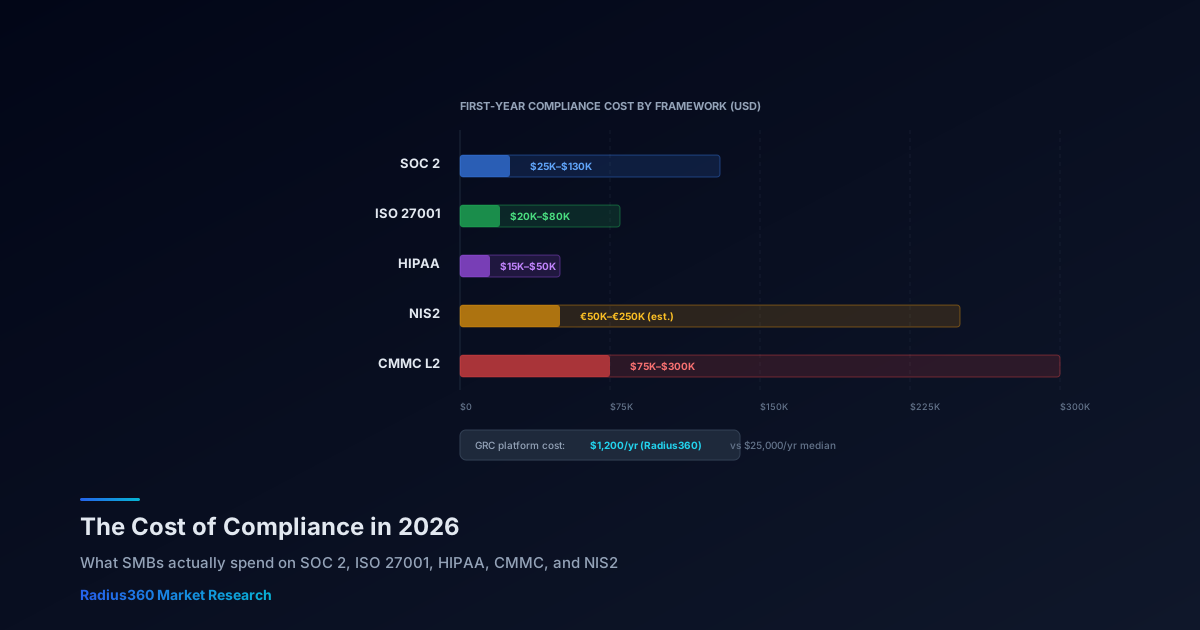
| Total first year | $25,000–$130,000 | |
| Annual renewal | $15,000–$60,000 |
The wide range reflects real differences in scope and company size. A small SaaS company with 50 employees pursuing a single Trust Services Criterion (Security only) will land at the low end — readiness assessment around $5,000, audit around $15,000, and a lean GRC platform. A mid-market company with 200 employees pursuing Security, Availability, and Confidentiality criteria will pay significantly more: $30,000 or more for the audit alone, plus a platform that can handle the additional evidence requirements.
The biggest variable most companies underestimate is internal labor. According to data from Sprinto and Secureframe, first-time SOC 2 programs require 200 to 500 hours of internal staff time — your engineering team configuring controls, your HR team documenting policies, your IT team pulling access reviews. At a fully loaded cost of $75 to $150 per hour, that labor alone adds $15,000 to $75,000 to the real cost. For a deeper walkthrough of the audit prep process, see our SOC 2 audit preparation guide.
Renewal years are cheaper because the readiness assessment is already done, your controls are established, and your auditor is familiar with your environment. But the GRC platform cost, penetration test, and internal labor to maintain evidence all recur annually.
ISO 27001 — Full Cost Breakdown
ISO 27001 is the international gold standard for information security management systems (ISMS). Unlike SOC 2, which is a U.S.-centric attestation, ISO 27001 is recognized globally — making it the framework of choice for companies selling into European, Asian, and multinational markets. Certification is issued by an accredited certification body and lasts three years, with annual surveillance audits in between.
| Cost Component | Range | Notes |
|---|---|---|
| Gap analysis | $2,000–$5,000 | Initial assessment |
| Implementation (consultant) | $10,000–$60,000 | ISMS build-out, 6-9 months |
| Certification audit (Stage 1+2) | $8,000–$25,000 | Accredited certification body; 2026 rates rising ~20% due to auditor shortages |
| GRC platform | $1,200–$50,000/yr | Tool cost |
| Internal labor | 300–600 hours | Over 6-12 months |
| Total first year | $20,000–$80,000 | |
| Annual maintenance | $10,000–$25,000 | Surveillance audits + internal audit |
| Year 3 recertification | $15,000–$30,000 |
A critical detail many companies miss: ISO 27001 certification lasts three years, while SOC 2 reports are annual. When you amortize the cost over the certification cycle, ISO 27001 often has a lower annualized cost than SOC 2 — particularly because the surveillance audits in years 2 and 3 are significantly less expensive than the initial certification audit.
The implementation phase is where most of the cost lives. Building an ISMS from scratch requires documenting your scope, conducting a formal risk assessment, creating a Statement of Applicability (mapping all 93 Annex A controls), developing policies and procedures, implementing controls, and running an internal audit — all before the certification body arrives. Consultants charge $10,000 to $60,000 for this work depending on company size and complexity. If you're weighing which framework to pursue first, our SOC 2 vs ISO 27001 comparison breaks down the decision factors.
For companies that already have a SOC 2 program, adding ISO 27001 is substantially cheaper because roughly 80% of the controls overlap. We cover this in detail in Section 9 below.
CMMC Level 2 — Full Cost Breakdown
The Cybersecurity Maturity Model Certification (CMMC) is the U.S. Department of Defense's framework for protecting Controlled Unclassified Information (CUI) in the defense industrial base. CMMC Level 2 maps directly to the 110 security practices in NIST SP 800-171 and requires a third-party assessment by an authorized C3PAO (CMMC Third-Party Assessment Organization).
| Cost Component | Range | Notes |
|---|---|---|
| Gap assessment | $5,000–$25,000 | Against 110 NIST 800-171 practices |
| Remediation & implementation | $10,000–$250,000+ | Largest variable — depends on current maturity |
| SSP & POA&M documentation | $3,000–$25,000 | System Security Plan |
| C3PAO assessment | $35,000–$55,000 | Third-party assessor |
| Total first cycle | $75,000–$300,000 | 78% of orgs spend $138K–$285K |
| Annual affirmation | ~$1,500/yr |
There is no way to sugarcoat it: CMMC is the most expensive compliance framework for SMBs, and it's not close. The remediation line item — which can exceed $250,000 on its own — is the reason. Many defense contractors have operated for years with significant gaps in their NIST 800-171 implementation. When they finally conduct a gap assessment, they discover they need to implement FIPS-validated encryption, deploy a SIEM, establish a formal incident response capability, segment their CUI environment, and dozens of other controls that require real infrastructure investment.
According to industry surveys from the Cyber AB and defense contractor associations, 78% of organizations pursuing CMMC Level 2 spend between $138,000 and $285,000 in the first cycle. Small manufacturers — the backbone of the defense supply chain — are particularly hard hit, as they often lack dedicated IT staff and must outsource nearly every aspect of implementation. For a detailed walkthrough of the CMMC requirements, see our CMMC 2.0 Level 2 compliance guide.
The silver lining is the annual affirmation cost. Unlike SOC 2 (annual audit) and ISO 27001 (surveillance audits), CMMC Level 2 certification lasts three years with only an annual affirmation — essentially a senior leader attesting that the organization is still meeting all 110 practices. The affirmation itself is minimal in cost, but maintaining the controls and evidence to back that affirmation still requires ongoing investment in labor and tooling.
HIPAA — Full Cost Breakdown
HIPAA compliance is mandatory for covered entities (healthcare providers, health plans, clearinghouses) and their business associates. Unlike SOC 2 and ISO 27001, there is no formal certification for HIPAA — compliance is enforced through OCR (Office for Civil Rights) audits and breach investigations. But the lack of a formal audit doesn't make it cheap.
| Cost Component | Range | Notes |
|---|---|---|
| Risk assessment | $5,000–$15,000 | Required annual SRA |
| Policy development | $10,000–$25,000 | First-time comprehensive set |
| Training | $500–$1,500/yr | $10-50 per employee |
| BAA management | $500–$2,000/vendor | Business Associate Agreements |
| GRC platform | $500–$10,000/yr | Ongoing compliance management |
| Total first year | $15,000–$50,000 | Small practice (1-10 providers) |
| Annual ongoing | $5,000–$15,000 |
The numbers above reflect a small healthcare practice or a SaaS business associate with 1 to 10 providers. Larger health systems and hospital networks spend orders of magnitude more — but those organizations are not the audience for this report.
Here is the context that makes these numbers meaningful: the average cost of a healthcare data breach in 2025 was $10.93 million, according to the IBM/Ponemon Cost of a Data Breach Report. Healthcare has held the top spot for the most expensive breach industry for 13 consecutive years. A $15,000 to $50,000 first-year compliance investment is a rounding error compared to the financial, reputational, and regulatory consequences of a breach. OCR penalties alone range from $100 per violation (for unknowing violations) to $50,000 per violation with an annual maximum of $1.5 million per violation category — and recent enforcement actions have exceeded $4 million.
The Security Risk Assessment (SRA) is the anchor of HIPAA compliance and the most commonly cited deficiency in OCR audits. It is required annually, must be documented, and must address administrative, physical, and technical safeguards. Many small practices try to do this on a spreadsheet, which technically satisfies the requirement — but creates enormous risk if the spreadsheet is incomplete, outdated, or fails to identify critical risks.
NIS2 — Cost Breakdown
The EU's Network and Information Security Directive 2 (NIS2) went into full effect in October 2024, replacing the original NIS Directive and dramatically expanding scope. Where NIS1 covered roughly 1,100 entities across the EU, NIS2 covers an estimated 5,500 or more entities across 18 critical and important sectors. For SaaS vendors selling to EU customers, NIS2 compliance is increasingly a procurement requirement — see our guide on what EU customers demand from SaaS vendors under NIS2.
Unlike SOC 2, ISO 27001, and CMMC, NIS2 does not have a formal certification audit. Compliance is enforced by national supervisory authorities in each EU member state, with penalties of up to 10 million euros or 2% of global annual turnover — whichever is higher. Perhaps most notably, NIS2 introduces personal liability for management bodies: directors and C-suite executives can be held personally responsible for compliance failures.
Cost data for NIS2 is less precise than for established frameworks because implementation is still early and varies significantly by member state. Based on ENISA guidance (which spans nearly 200 pages of security measures), industry estimates, and early implementation reports, the ranges for a mid-market organization are:
- Risk assessment and gap analysis: €5,000–€25,000
- Policy and procedure development: €10,000–€40,000
- Technical controls implementation: €20,000–€100,000+
- Supply chain security measures: €5,000–€30,000
- Incident reporting capability: €5,000–€20,000
- Management training and governance: €3,000–€10,000
- Estimated total implementation: €50,000–€250,000
These estimates are directional, not precise, and will vary substantially based on the member state (each transposes the directive differently), the sector, the organization's existing security maturity, and whether the organization already holds ISO 27001 certification. Organizations that are already ISO 27001 certified have a significant head start, as the frameworks share substantial overlap in risk management, incident response, and governance requirements.
GRC Platform Cost Comparison
The GRC platform is a recurring annual cost that compounds over time, so choosing the right one matters. Here is how the market looks as of April 2026, based on vendor pricing pages, G2 reviews, and published market data.
| Platform | Annual Cost (median) | Per-framework add-on | Multi-client | Notes |
|---|---|---|---|---|
| Radius360 Starter | $1,188/yr | Included | Up to 3 | Published pricing, no sales call |
| Radius360 Professional | $3,588/yr | Included | Up to 10 | Published pricing |
| Sprinto | ~$15,000/yr | — | No | Popular with startups |
| Secureframe | ~$7,500+/yr | — | No | |
| Drata | ~$25,000/yr median | $3K–$10K each | No | Foundation to Enterprise |
| Vanta | ~$20,000/yr median | — | No | Basic to Enterprise |
| ServiceNow GRC | $50,000+/yr | Module pricing | No | Plus implementation |
These figures are compiled from vendor pricing pages, G2 reviews, and published market data as of April 2026. Competitor pricing is not published by all vendors and may vary.
Several things stand out in this comparison. First, the pricing spread is enormous — the difference between the least expensive and most expensive option is more than 40x. Second, most enterprise-grade platforms charge separately for each compliance framework, meaning a company pursuing SOC 2 and ISO 27001 simultaneously could pay $6,000 to $20,000 more per year in framework add-on fees alone.
Third — and this is critical for vCISOs and MSSPs — most platforms are designed for single-company use. If you manage compliance programs for 5 or 10 clients, you need 5 or 10 separate subscriptions, which means your platform cost can easily reach $100,000 to $250,000 per year. Multi-tenant platforms like Radius360, which allow managing multiple clients from a single subscription, fundamentally change the unit economics of compliance service delivery.
For a more detailed platform comparison, including feature-by-feature analysis, see our comparison of Drata, Vanta, and Radius360.
The Hidden Costs Nobody Talks About
The tables above capture the direct, visible costs. But the real cost of compliance includes several categories that rarely appear in vendor marketing materials.
Internal labor is the biggest hidden cost. A first-time compliance program requires 200 to 600 hours of internal staff time — and that time comes from your engineering, IT, HR, and operations teams. These are not marginal hours. They are hours your team is not spending on product development, customer support, or revenue-generating activities. At a fully loaded cost of $75 to $150 per hour, internal labor adds $15,000 to $90,000 to the real cost of compliance. Most budget proposals omit this entirely.
Opportunity cost compounds the labor problem. While your senior engineer is configuring SSO controls and documenting access review procedures, they are not shipping features. While your operations lead is building an asset inventory, they are not improving processes. The opportunity cost is invisible on a P&L statement, but it is real — and it is the primary reason that compliance programs take longer than expected.
Scope creep is the cost that keeps growing. You start with SOC 2 because your largest prospect requires it. Six months later, a European customer asks for ISO 27001. Then your cyber insurance carrier wants to see NIST CSF alignment. Each additional framework has marginal cost — they overlap significantly — but the marginal cost is not zero. Without a platform that supports cross-framework mapping, each new framework means another round of evidence collection, policy review, and audit preparation.
Tool switching costs catch companies off guard. Many companies start their compliance journey on spreadsheets and shared drives. It works — barely — for the first audit. By the second year, the spreadsheets are unmaintainable, evidence is scattered, and the team realizes they need a platform. Migrating mid-compliance means re-mapping controls, re-uploading evidence, and retraining staff. The migration itself can cost 40 to 80 hours of labor, and there is always a risk of losing evidence continuity during the transition.
Failed audits are the cost no one budgets for. If your SOC 2 auditor finds that controls were not operating effectively throughout the observation period, you get exceptions in your report — or worse, a qualified opinion. The cost of remediation and re-audit can add $10,000 to $30,000 to your program, plus the reputational damage of delivering a report with exceptions to a customer who requested a clean one.
How to Reduce Compliance Costs
Compliance is expensive, but it doesn't have to be wasteful. Here are five strategies that consistently reduce total cost of ownership.
Start with one framework, then map to others. SOC 2 and ISO 27001 share approximately 80% control overlap. NIST CSF maps to nearly every other framework. If you build your compliance program on a strong first framework with cross-framework mapping built in, adding the second framework costs roughly 30% more — not 100% more. This is the single highest-leverage cost reduction strategy, and it requires choosing a GRC platform that supports control mapping across frameworks from day one.
Automate evidence collection. Manual evidence collection — pulling screenshots, exporting CSVs, downloading configurations — accounts for an estimated 60% of audit preparation labor. Platforms that integrate directly with your cloud infrastructure, identity provider, endpoint management, and HR systems can collect this evidence automatically and continuously, reducing audit prep from weeks to hours. This is the difference between compliance as a quarterly fire drill and compliance as a background process.
Use a multi-tenant platform if you're a vCISO or MSSP. The economics are straightforward: if you manage 10 clients on single-tenant platforms at $20,000 each, your platform cost is $200,000 per year. On a multi-tenant platform at $3,588 per year for up to 10 clients, your platform cost drops by over 98%. The savings go directly to your margin — or allow you to offer compliance services at price points that SMBs can actually afford. BlueRadius uses this model to deliver enterprise-grade compliance programs to SMBs at a fraction of the traditional cost.
Bundle frameworks whenever possible. Because of the control overlap between major frameworks, pursuing two frameworks simultaneously is dramatically cheaper than pursuing them sequentially. SOC 2 + ISO 27001 together costs roughly 30% more than SOC 2 alone — not twice as much. The audit prep labor is shared, the controls are shared, and the evidence largely overlaps. If your customers require multiple frameworks, bundling the implementation saves both money and time.
Consider a vCISO instead of a full-time CISO. A full-time CISO costs $200,000 or more in salary alone, plus benefits, equity, and the organizational overhead of a senior executive hire. A vCISO retainer runs $60,000 to $100,000 per year and provides experienced security leadership on a fractional basis. For companies with 20 to 200 employees, a vCISO is almost always the right call — you get the expertise without the overhead, and you can scale up to a full-time hire when the organization is large enough to justify it.
Bottom Line — What to Budget
Here is what companies should actually budget for compliance in 2026, based on all the data in this report. These figures include direct costs (assessments, audits, platforms, testing) and internal labor, but do not include remediation costs for companies with significant security gaps.
| Company Size | First Framework | Adding Second | Annual Maintenance |
|---|---|---|---|
| Startup (20 employees) | $20,000–$40,000 | +$10,000–$20,000 | $12,000–$25,000 |
| SMB (50-200 employees) | $35,000–$80,000 | +$15,000–$30,000 | $20,000–$45,000 |
| Mid-market (200-500 employees) | $60,000–$150,000 | +$25,000–$50,000 | $35,000–$75,000 |
| Defense contractor (CMMC) | $75,000–$300,000 | N/A | $15,000–$30,000 |
These ranges assume companies are using a GRC platform (not spreadsheets), have basic security hygiene in place (SSO, endpoint management, access reviews), and are working with experienced auditors or consultants. Companies starting from zero — no policies, no risk register, no formal security controls — should budget toward the high end or beyond.
The defense contractor row is an outlier because CMMC Level 2 remediation costs are uniquely unpredictable. A company that has been diligently implementing NIST 800-171 for years may spend $75,000. A company that has been self-attesting without actually implementing controls — a common scenario in the defense industrial base — may spend $300,000 or more just on remediation before the C3PAO ever arrives.
For more context on how compliance investments interact with insurance requirements, see our analysis of what cyber insurance carriers actually check in 2026. And for a foundational understanding of what GRC is and why it matters, start there if this report is your first exposure to the space.
Compliance costs are real, but they are manageable — especially with the right platform and the right strategy. Radius360 gives SMBs, vCISOs, and MSSPs the tools to manage compliance programs at a fraction of the traditional cost, with published pricing, multi-tenant support, and 20+ frameworks included in every plan. Start your compliance program today or schedule a free compliance assessment to find out exactly where you stand.
Frequently Asked Questions
See how Radius360 helps
Put these ideas into practice with the right tooling.
Start Your Compliance ProgramThe vCISO Playbook
Lesson 6 of 10