Why Most Board Briefings Fail
Most CISOs dread board presentations. The presentation gets built the week before, crammed with technical metrics that made sense in the SOC but mean nothing in the boardroom. The CISO speaks for 20 minutes. The board nods politely. Someone asks "so are we secure?" and the CISO gives a hedged answer that satisfies no one. The topic gets tabled until next quarter.
The problem is not that boards do not care about security. They do — especially post-breach, post-regulation, and post-insurance-renewal. The problem is that most CISOs present security the way they think about it (threats, vulnerabilities, controls, tools) rather than the way boards think about it (risk to the business, trajectory of improvement, investment needed).
Board reporting is a communication discipline, not a technical exercise. The goal is not to prove how much you know — it is to give the board enough information to make governance decisions about security investment, risk tolerance, and strategic direction.
If you are new to governance, risk, and compliance as a discipline, understanding the governance pillar is especially important for board communication. Governance is how the organization makes decisions about security — and the board is where those decisions happen.
The Three Questions Every Board Actually Asks
Strip away the formality and every board is asking three questions:
1. Are we at risk?
The board wants to know: what could hurt us, how likely is it, and how bad would it be? They do not want a list of every vulnerability in your scan results. They want a clear picture of the risks that could materially impact the business — financial loss, regulatory action, reputational damage, operational disruption.
Your answer should connect security risks to business outcomes. "We have 47 critical vulnerabilities" means nothing. "We have three unpatched systems in our payment processing environment that, if exploited, could expose customer financial data and trigger PCI notification requirements" means everything.
2. Are we improving?
The board wants trend lines, not snapshots. Are we more secure than last quarter? Are we closing gaps faster? Are the investments we made last year producing results?
This is where your risk register becomes a board reporting tool. If you can show that high-severity risks decreased from 12 to 7 over two quarters, and that the average time to mitigate dropped from 45 days to 22 days, the board can see that the program is working — even if the raw numbers are still not perfect.
3. What do you need?
The board controls budget and strategic priority. If you need headcount, tooling, a new initiative, or executive support for a policy change, the board presentation is where you make the case. But the ask must be connected to the risks and trends you just presented. "I need $200K for a new SIEM" is a cost. "Investing in centralized detection will close our visibility gap in cloud infrastructure, which is the source of three of our top five risks" is a business case.
Structuring a 15-Minute Briefing
Fifteen minutes is enough. In fact, it is better than 30 because it forces you to prioritize. Here is a structure that works:
Minutes 1-3: Posture Summary
Open with a single-page view of your security posture. This should include:
- An overall posture score or maturity rating that the board can track quarter over quarter
- A comparison to last quarter (trending up, down, or flat)
- The number of frameworks in scope and their completion percentages
Do not explain methodology. The board does not care how you calculate the score — they care what it means and whether it is going in the right direction.
Minutes 4-8: Top Risks
Present your top three to five risks in business language. For each risk:
- What is it (one sentence, no jargon)
- What is the business impact if it materializes
- What are you doing about it (mitigation status)
- What is the timeline to resolution
This is the "are we at risk?" answer. Source these directly from your risk register so the data is consistent and traceable.
Minutes 9-11: Program Progress
Show what the security program accomplished since the last board meeting:
- Controls implemented or improved
- Frameworks advanced (e.g., "SOC 2 readiness moved from 68% to 84%")
- Incidents handled and lessons learned
- Third-party assessment results
This is the "are we improving?" answer. Use trend charts, not tables. Boards process visual trends faster than numbers in rows.
Minutes 12-15: Ask and Discussion
Close with your ask. If you need budget, headcount, or a policy decision, present it here — after you have established the risk context and demonstrated program progress. Connect every ask to a specific risk or gap you just discussed.
Leave time for questions. The best board conversations happen when the CISO stops talking and the board starts asking. If you have structured the briefing well, their questions will be about business decisions, not technical clarifications.
Metrics That Matter vs Metrics That Don't
Metrics Boards Care About
- Posture score trend — a single number tracked over time that represents overall security maturity
- High-risk count and trajectory — how many material risks exist and whether that number is shrinking
- Time to mitigate — how quickly you close identified risks (faster is better, and the trend matters more than the absolute number)
- Framework compliance percentage — especially for frameworks tied to revenue (SOC 2 for enterprise sales, CMMC for DoD contracts)
- Incident count and severity — not every alert, just the incidents that required a response and their business impact
- Third-party assessment results — audit findings, penetration test outcomes, insurance carrier evaluations
Metrics Boards Do Not Care About
- Number of vulnerabilities scanned
- Firewall rules configured
- Phishing simulation click rates (unless tied to a trend or initiative)
- Number of patches applied
- Alert volume from your SIEM
- Tool-specific dashboards
The distinction is context. A metric matters to the board when it connects to business risk, revenue, or regulatory exposure. A metric does not matter when it describes operational activity without business context.
If you are working with clients who need to satisfy cyber insurance requirements, many of the board-relevant metrics overlap with what carriers evaluate — posture scoring, incident response readiness, and framework compliance.
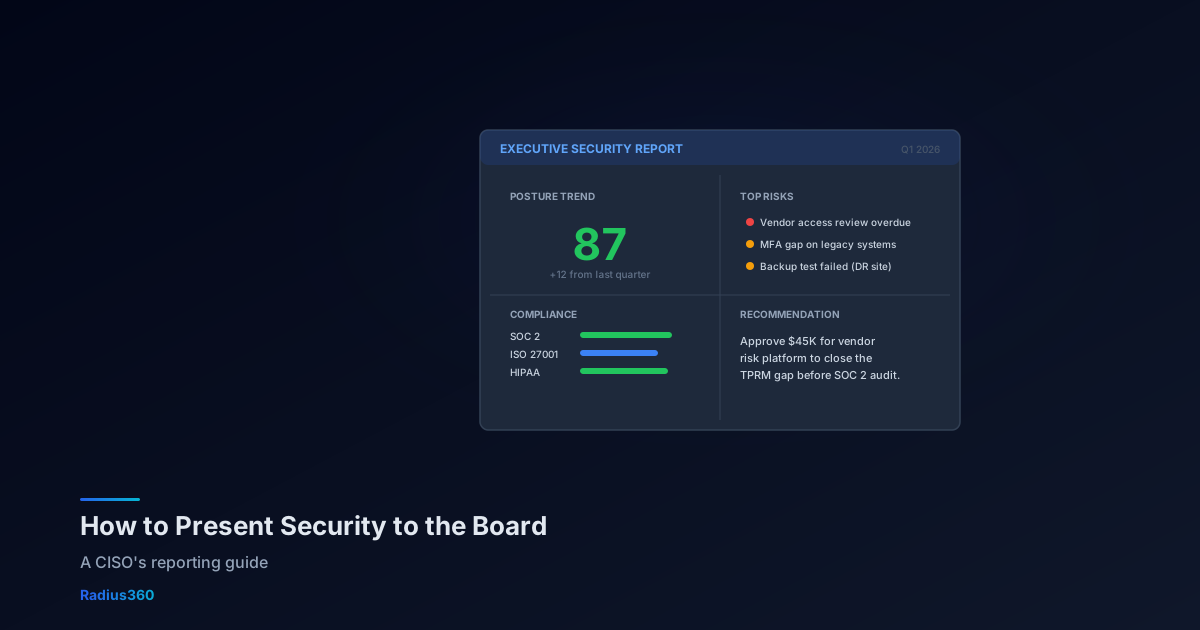
The One-Page Four-Quadrant Format
The most effective board security report fits on a single page divided into four quadrants:
Quadrant 1: Posture Score (Top Left)
A single number or rating with a trend arrow. Green/yellow/red status. Quarter-over-quarter comparison. This is the first thing the board sees and sets the tone for the conversation.
Quadrant 2: Top Risks (Top Right)
Three to five risks listed with business impact and mitigation status. Use plain language. Each risk should be understandable by someone with no security background.
Quadrant 3: Program Progress (Bottom Left)
Key accomplishments since the last report. Framework completion percentages. Milestones achieved. Use bullet points, not paragraphs.
Quadrant 4: Investment Ask (Bottom Right)
What you need and why. Connect each request to a specific risk from Quadrant 2 or a gap in Quadrant 3. Include estimated cost and expected impact.
This format works because it gives the board everything they need in a single view. They can scan all four quadrants in 30 seconds and then spend the remaining time on discussion rather than wading through slides.
For vCISOs managing multiple clients, this format is especially powerful because you can generate it from your GRC platform data rather than building custom presentations for each client. The data sources — risk register, framework scores, evidence collection status, incident log — feed directly into the four quadrants.
Handling "Are We Secure?"
Every CISO gets this question. The instinct is to hedge: "Security is a journey, not a destination." That answer, while technically correct, frustrates boards because it feels evasive.
A better answer has three parts:
1. Acknowledge the question directly. "That is the right question, and I can give you a specific answer."
2. Reframe in terms of risk posture. "We are well-protected against the threats most likely to affect our business. Our controls cover 87% of the NIST framework requirements, our high-severity risks are down 40% from last quarter, and our incident response plan has been tested within the past 90 days."
3. Name what keeps you up at night. "The area where I want to improve is our cloud infrastructure visibility. We added three new SaaS tools this quarter without security review, and I've flagged that as a risk with a mitigation plan underway."
This answer gives the board confidence without making promises you cannot keep. It demonstrates competence (you know your numbers), transparency (you name the gaps), and leadership (you have a plan).
Building Board Confidence Over Time
The first board presentation is the hardest. By the third, the board knows your format, expects your metrics, and asks better questions. Consistency is the key to building confidence.
Use the same format every quarter. The board should be able to compare this quarter's report to last quarter's at a glance. Changing formats makes it harder to see trends and signals that you do not have a stable program.
Track the same metrics. If you reported posture score, risk count, and framework completion last quarter, report the same metrics this quarter. Add new metrics only when you add new programs or the board requests them.
Follow up on previous asks. If you requested budget last quarter and received it, show the impact this quarter. "The $150K investment in endpoint detection resulted in a reduction of our mean time to detect from days to hours" closes the loop and builds trust for future asks.
Deliver bad news early. If there was a security incident or a failed audit, do not wait for the board to find out from someone else. Present it proactively with your analysis and response plan. Boards respect CISOs who deliver bad news directly — and lose confidence in CISOs who minimize or delay.
BlueRadius helps CISOs and vCISOs build board reporting programs that generate confidence through consistent, data-driven communication rather than slide decks built under deadline pressure.
Frequently Asked Questions
How often should I present security to the board?
Quarterly is standard for most organizations. Some boards with elevated risk profiles or active security programs request monthly updates. Between formal presentations, consider sending a one-page posture summary so the board stays informed without requiring a meeting.
What if my board has no security expertise?
That is normal and actually makes your job easier in some ways. A non-technical board will not challenge your technical decisions — they want to understand business risk, program trajectory, and investment needs. Use plain language, avoid acronyms, and connect every metric to a business outcome.
Should I include technical details in board reports?
No. Keep technical details in an appendix that board members can review if they choose. The main report should be entirely in business language. If a board member asks a technical follow-up question, answer it directly — but do not lead with technical depth.
How do I get more board time for security?
Earn it by making your current time valuable. If the board leaves every meeting feeling informed and confident in your program, they will naturally allocate more time. If they leave confused or uncertain, they will reduce your slot. Quality of communication matters more than quantity of time.
What tools help generate board-ready security reports?
GRC platforms that track risk registers, framework compliance, and posture scores can generate board reports from live data rather than requiring manual assembly. Look for platforms with one-click report generation that pulls from your actual security program data — not templates.
Need a board report right now? Use our free Board Report Template — fill in 6 fields, download a branded one-page PDF in 60 seconds, no signup required. Ready to generate board reports from live security data automatically? Start your free trial of Radius360 and use the built-in board report generator to create executive summaries from your risk register, framework scores, and posture trends. For help building a board reporting program, contact BlueRadius.
The vCISO Playbook
Lesson 7 of 10