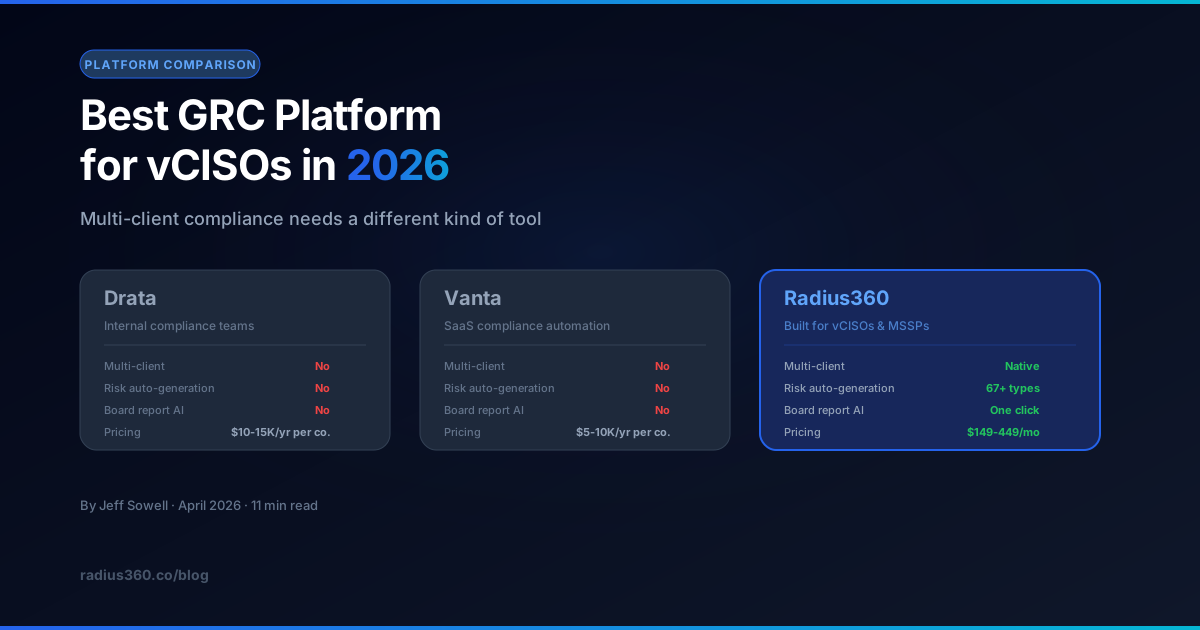
The problem with choosing a GRC platform as a vCISO
If you've been searching for a GRC platform, you've probably seen Drata and Vanta at the top of every list. And for good reason — they're solid products that have raised hundreds of millions in funding and built strong brands around compliance automation.
But here's the thing those reviews don't tell you: Drata and Vanta were built for internal compliance teams at a single company. They assume one organization, one set of frameworks, one team managing everything. That model breaks down the moment you're a consultant managing 5, 10, or 25 client programs simultaneously.
This guide breaks down what actually matters when you're choosing a GRC platform as a vCISO, MSSP, or security consultant — and where the major platforms diverge.
What vCISOs actually need (that enterprise GRC tools don't prioritize)
Before comparing tools, let's establish what a multi-client security practitioner actually requires:
- Multi-tenant isolation — each client's data, frameworks, risks, and policies must be completely separate. Not "workspaces" bolted onto a single-tenant architecture.
- Reusable templates — onboarding a new client shouldn't mean rebuilding everything from scratch. Pre-built risk registers, policy templates, and framework configurations that you customize, not recreate.
- Cross-framework mapping — when you assess a SOC 2 control, it should automatically map to ISO 27001, NIST, and HIPAA. Assess once, satisfy multiple frameworks. (See our NIST CSF 2.0 implementation guide for how this works in practice.)
- Deep integrations that do the work — not just evidence collection, but auto-generated risks mapped to framework controls from live data (M365 Secure Score, AWS findings, CrowdStrike detections). (We wrote about automating evidence collection and why it matters.)
- Board-ready output — your deliverable is the narrative, not the data. One-click reports that explain posture in plain language, not dashboards full of charts your client's CEO won't understand.
- Practitioner economics — pricing that works when you're managing multiple client programs, not enterprise pricing designed for a single large organization.
Drata: Built for internal teams, strong on automation
Best for: Mid-market companies running their own SOC 2 or ISO 27001 program internally.
What Drata does well:
- Continuous compliance monitoring with automated evidence collection
- Strong integration library for pulling evidence from cloud infrastructure
- Clean dashboard for tracking control status across a single organization
- Good auditor experience — many audit firms are familiar with Drata's output
Where it falls short for vCISOs:
- Single-tenant architecture. Drata is designed for one company managing its own compliance. There's no native multi-client model where a practitioner manages 10 separate programs from a single login.
- No risk register depth. Drata's risk management is compliance-first — it tracks control status, not security risks with business impact, likelihood scoring, and mitigation plans. (If you're building a risk register from scratch, here's how to do it right.)
- No AI policy generation from live data. Policies are templates, not documents generated from your client's actual environment (their Secure Score, MFA gaps, open vulnerabilities).
- Pricing scales per company. If you're managing 8 clients, you're paying for 8 separate Drata instances. That math gets expensive quickly.
- Limited security operations. No incident management, no posture scoring, no integration-driven risk auto-population. It's a compliance tool, not a security operations tool.
Drata pricing: Starts around $10,000-15,000/year per organization. Multiplied across client programs, this becomes the dominant cost in your practice.
Vanta: Compliance automation with broader framework coverage
Best for: SaaS companies and startups that need SOC 2 fast, with some ISO 27001 and HIPAA capability.
What Vanta does well:
- Fast time-to-SOC-2 with guided setup and automated evidence collection
- Broad framework support including SOC 2, ISO 27001, HIPAA, PCI DSS, and GDPR
- Trust Center for publishing your compliance status externally
- Vendor risk management basics
- Strong ecosystem of auditor partnerships
Where it falls short for vCISOs:
- Same single-tenant limitation as Drata. You cannot manage multiple independent client programs from one account. Each client needs their own Vanta subscription.
- Compliance-first, security-second. Like Drata, Vanta focuses on proving compliance to auditors rather than managing the actual security program. Risk management is surface-level.
- No deep integration analysis. Vanta collects evidence from integrations but doesn't analyze the data to auto-generate risks. It doesn't tell you "your client's MFA coverage is 68% — here's a risk mapped to NIST PR.AA and CIS 6.3."
- No executive narrative. Dashboards show control status, but there's no AI-generated board report that weaves posture data into a story. You're still building the slide deck yourself.
- Pricing follows the same per-company model. Every client program is a separate cost center.
Vanta pricing: Starts around $5,000-10,000/year per organization depending on framework count.
Radius360: Built for practitioners managing multiple clients
Best for: vCISOs, security consultants, and MSSPs who manage compliance and security programs for multiple clients simultaneously.
What Radius360 does differently:
Multi-client native from day one
Switch between client workspaces in one click. Each tenant has fully isolated data — risks, frameworks, evidence, policies, and posture scores. One login, one dashboard, all your clients. This isn't a feature added later; it's the architectural foundation.
Security operations + compliance in one platform
Radius360 doesn't stop at compliance checklists. It connects incident response, risk management, posture scoring, and evidence collection into a single system. When the board asks "are we improving?" — you open the posture trend chart, not a spreadsheet.
Deep integrations that auto-generate risks
Connect M365, AWS, Okta, CrowdStrike, SentinelOne, Tenable, KnowBe4, Splunk, or Sentinel — and the platform pulls live posture data, identifies gaps, and auto-generates risks mapped to NIST CSF, CIS, CMMC, ISO 27001, and HIPAA. Not just evidence collection — actual security analysis.
AI that reads your environment
Generate a policy and the AI already knows your client's Secure Score is 47, MFA is only on 68% of accounts, and three S3 buckets are public. The resulting policy references real metrics and includes remediation timelines — not generic boilerplate.
Board report in one click
A single "Generate Board Report" button produces an 8-section executive briefing: posture overview, key risks, compliance status, integration health, what changed, and action items. Grounded in live data. Ready for the boardroom.
30 compliance frameworks, 5,000+ controls
SOC 2, ISO 27001, HIPAA, HITRUST, NIST CSF (v1.1 and v2.0), CMMC, PCI DSS, GDPR, CCPA/CPRA, DORA, NIS2, FedRAMP, EU AI Act, and more. Cross-framework mapping means assessing a control for SOC 2 automatically maps it to ISO 27001.
Practitioner-friendly pricing
$149/month for up to 3 clients. $449/month for up to 10. Not per-client, not per-framework. The economics work for a consultancy, not just a large enterprise.
Side-by-side comparison
| Capability | Drata | Vanta | Radius360 |
|---|---|---|---|
| Primary audience | Internal compliance teams | Internal compliance teams | vCISOs, consultants, MSSPs |
| Multi-client management | No (separate instances) | No (separate instances) | Yes — native multi-tenant |
| Compliance frameworks | ~15 | ~25 | 30 with cross-mapping |
| Risk management depth | Basic (control status) | Basic (control status) | Full register with AI scoring |
| Deep integrations | Evidence collection | Evidence collection | Auto-generated risks mapped to controls |
| AI policy generation | Templates | Templates | From live environment data |
| Board report generator | No | No | One-click, AI-generated |
| Incident management | No | Basic | Full lifecycle with SIEM ingestion |
| Posture scoring | No | No | Composite 0-100 with trend |
| Security story narrative | No | No | Copy-paste board bullets |
| Pricing model | Per company ($10-15K/yr) | Per company ($5-10K/yr) | Per practitioner ($149-449/mo) |
When to choose each platform
Choose Drata if:
- You're an internal compliance team at a single mid-market company
- Your primary goal is SOC 2 audit automation
- You have a large budget for a single compliance program
- You need deep auditor firm integrations (many firms have Drata partnerships)
Choose Vanta if:
- You're a SaaS startup that needs SOC 2 quickly
- You want a Trust Center to share compliance status publicly
- You're a single organization managing 2-3 frameworks
- Speed to first audit is your top priority
Choose Radius360 if:
- You manage security or compliance programs for multiple clients
- You need risk management depth beyond compliance checklists
- You want integrations that analyze data, not just collect evidence
- You need AI that generates policies and reports from live posture data
- You want one platform that covers compliance, risk, incidents, and board reporting
- Pricing per-client-instance would break your practice economics
The bottom line
Drata and Vanta are excellent compliance automation platforms. If you're managing a single company's SOC 2 program, they'll serve you well.
But if you're a practitioner — a vCISO, consultant, or MSSP — managing multiple clients, you're not their target customer. You need multi-tenant isolation, security operations depth, AI that understands your clients' actual environments, and pricing that doesn't multiply by client count.
That's the gap Radius360 fills. It's not a better Drata — it's a different tool for a different job.
Ready to see the difference? Start a free 7-day trial with full Professional features — no credit card required.
Radius360 is built by BlueRadius, a cybersecurity consultancy that delivers vCISO services, regulatory compliance, and AI governance programs — so the platform is designed by practitioners, for practitioners. See our essential vCISO tech stack guide for more on building an efficient practice.
Frequently asked questions
Can I migrate from Drata or Vanta to Radius360?
Yes. Radius360 supports the same frameworks (SOC 2, ISO 27001, HIPAA, etc.) and you can import your existing risk register and policies. The main migration effort is reconnecting your integrations, which typically takes 1-2 hours per client.
Does Radius360 work with my auditor?
Radius360 generates audit-ready evidence mapped to framework controls. Any auditor familiar with SOC 2, ISO 27001, or HIPAA can work with Radius360's output — it's not auditor-specific like some Drata partnerships.
How is Radius360 different from ServiceNow GRC?
ServiceNow is built for large enterprise IT departments with complex workflow automation needs. It requires significant implementation effort (often 6-12 months) and dedicated administrators. Radius360 is designed for security practitioners who need to be productive immediately — no implementation project required.
Is Radius360 secure enough for my clients' data?
Radius360 uses Supabase (PostgreSQL) with Row Level Security (RLS) for tenant isolation, encrypted connections, and SOC 2-aligned infrastructure. Each client's data is completely isolated at the database level — not just the UI level.
What integrations does Radius360 support?
46 integrations including M365, Google Workspace, AWS, Okta, CrowdStrike, SentinelOne, Tenable, KnowBe4, Splunk, Microsoft Sentinel, Sekoia XDR, Cloudflare API Shield, Akto, Supabase, GitHub, Jira, ServiceNow, and more. 20 of these are "deep integrations" that auto-generate risks AND per-control pass/fail evidence rows mapped to framework controls.
