Executive Summary
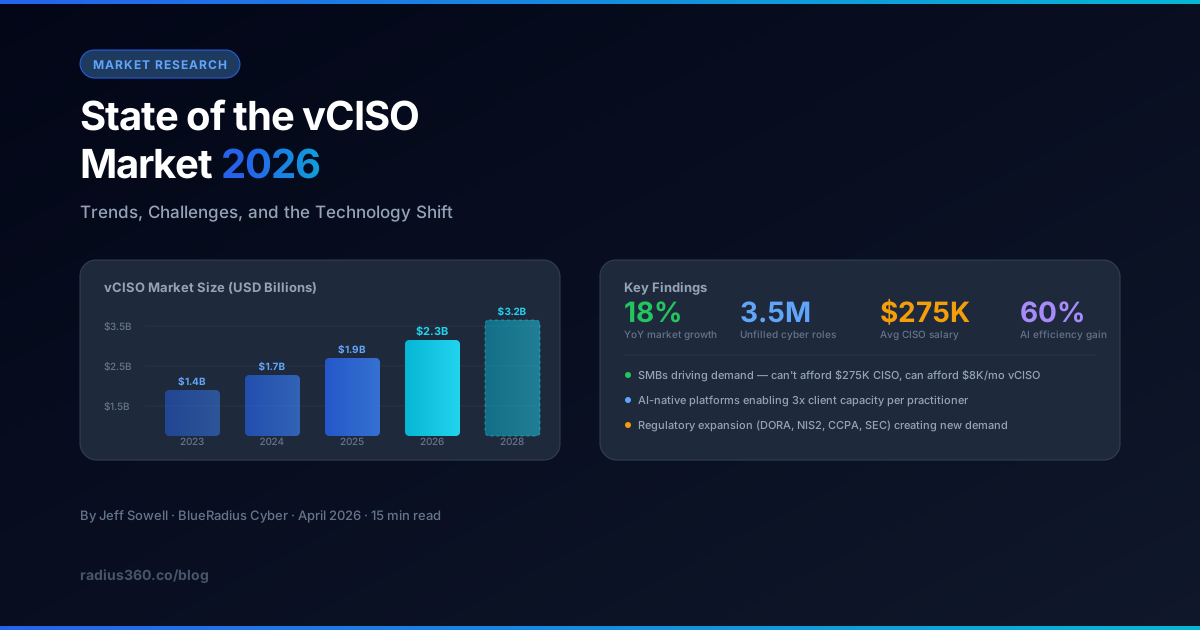
- The global vCISO and fractional security market is projected to grow from $1.9B in 2025 to $3.2B by 2027, representing a 30% CAGR fueled by regulatory expansion, cyber insurance mandates, and the persistent CISO talent shortage.
- SMBs are the primary growth driver. Organizations with 50–500 employees face the same compliance obligations as enterprises but cannot justify a $275K+ full-time CISO. The average vCISO retainer of $5–15K/month delivers equivalent strategic oversight at 15–25% of the cost.
- AI-native GRC platforms are reshaping practice economics. Practitioners using AI-powered tooling report managing 3x more clients than those relying on spreadsheets and manual processes, with 60%+ reductions in evidence collection time.
- The technology shift from spreadsheets to multi-tenant, AI-native platforms is the single biggest differentiator between practices that plateau at 5 clients and those that scale to 20+.
The vCISO Market in Numbers
The cybersecurity services market reached an estimated $192B globally in 2025 (Gartner), with managed security services and virtual/fractional CISO engagements representing one of the fastest-growing segments. While exact vCISO market sizing varies by source, triangulating data from ISACA, ISC2, and multiple industry surveys points to a current addressable market of approximately $1.9B in 2025, growing to $3.2B by 2027.
Key Market Metrics
| Metric | 2024 | 2026 (Est.) |
|---|---|---|
| Global vCISO market size | $1.5B | $2.4B |
| Average clients per solo vCISO | 3–5 | 5–8 (with platform tooling) |
| Average monthly retainer (SMB) | $5,000–$10,000 | $7,000–$15,000 |
| Average monthly retainer (Mid-market) | $12,000–$20,000 | $15,000–$25,000 |
| Most common engagement model | Monthly retainer (62%) | Monthly retainer (68%) |
| Practices using dedicated GRC platforms | 34% | 58% |
Engagement Models
The retainer model continues to dominate, but engagement structures are diversifying:
- Monthly retainer (68%): Fixed scope, predictable revenue. Most common for ongoing compliance management and security program oversight.
- Fractional/part-time (18%): Dedicated hours per week (typically 10–20), often with on-site presence. Popular with mid-market companies building internal teams.
- Project-based (14%): Scoped engagements for audit prep, incident response, or framework implementation. Higher per-hour rates but unpredictable pipeline.
Revenue Benchmarks
Solo vCISO practitioners running efficient, platform-enabled practices are generating $150K–$350K in annual revenue with 70%+ margins. Small teams of 2–4 practitioners are reaching $500K–$1.5M, and MSSP-style operations with dedicated compliance analysts are crossing $2M–$5M+.
The key variable is not market demand — it's operational efficiency. Practices still running on spreadsheets and manual evidence collection hit a hard ceiling at 4–6 clients. Those leveraging multi-tenant GRC platforms purpose-built for practitioners are pushing past 15–20 clients per senior vCISO.
What's Driving Growth
1. Regulatory Expansion
The regulatory landscape in 2026 is the most complex it has ever been — and it's accelerating.
In the United States:
- State privacy laws have multiplied. Following California's CCPA/CPRA, at least 19 states now have comprehensive data privacy legislation in effect, with another 8 in various stages of enactment. Each law carries unique requirements around data inventories, risk assessments, and consumer rights.
- SEC cybersecurity disclosure rules (effective December 2023) require public companies to report material incidents within four business days and disclose board-level cybersecurity oversight annually. This has cascaded into private company expectations — PE-backed firms and pre-IPO companies are now standing up formal security programs years earlier than they would have historically.
- Cyber insurance requirements have tightened dramatically. Carriers now routinely require evidence of MFA, EDR, vulnerability management programs, and formal incident response plans. Organizations without a formal security program — or someone to run it — are seeing premium increases of 30–60% or outright coverage denials.
- FTC enforcement actions around data security have increased 40% since 2023, with the agency applying Section 5 unfairness doctrine aggressively to companies lacking "reasonable security measures."
Internationally:
- EU's DORA (Digital Operational Resilience Act) went into effect January 2025, requiring financial entities and their ICT service providers to implement comprehensive risk management frameworks.
- NIS2 expanded the EU's cybersecurity requirements to cover 18 sectors, with personal liability for management bodies that fail to oversee cybersecurity risk.
- EU AI Act is creating entirely new compliance categories that vCISOs are being asked to advise on — often before formal guidance exists.
Each new regulation creates demand for someone to interpret it, build a compliance program around it, and maintain evidence of adherence. For the vast majority of SMBs, that someone is a vCISO.
2. The CISO Talent Gap
The math is straightforward and has not improved:
- Average base salary for a full-time CISO: $275,000–$420,000 (Heidrick & Struggles 2025 Global CISO Survey), not including equity, bonus, and benefits that push total compensation to $400K–$700K at mid-market and enterprise companies.
- Average tenure of a CISO: 26 months (IANS Research), meaning companies face recurring recruiting costs on top of compensation.
- Global cybersecurity workforce gap: 3.5 million unfilled positions (ISC2 2025 Cybersecurity Workforce Study), with the gap widening despite a 12.6% increase in the workforce year over year.
- Percentage of SMBs (50–500 employees) with a full-time CISO: Less than 12% (Ponemon Institute).
A vCISO retainer of $7,000–$15,000/month delivers strategic security leadership at 15–25% of the fully loaded cost of a full-time hire, with no recruiting timeline, no equity dilution, and no risk of the 26-month departure cycle. For companies that need CISO-level expertise but can't justify the headcount — which is the majority of organizations in the 50–500 employee range — virtual delivery is not a compromise. It's the rational economic choice.
3. AI Changing the Economics
This is the inflection point. AI is not replacing vCISOs — it's amplifying them.
Practitioners leveraging AI-powered GRC platforms are reporting measurable efficiency gains across every phase of service delivery:
- Policy generation: What took 4–8 hours per policy (research, drafting, client customization) now takes 30–60 minutes. AI generates framework-aligned drafts that practitioners refine, rather than writing from scratch.
- Gap assessments: AI-powered analysis of existing controls against framework requirements reduces initial assessment time from 2–3 weeks to 2–3 days.
- Evidence collection: Automated evidence collection through deep integrations with client environments (M365, AWS, Okta, EDR, SIEM) eliminates the manual screenshot-and-spreadsheet approach that consumed 30%+ of practitioner time.
- Risk identification: Platforms that analyze posture data from integrated tools and auto-generate risks mapped to framework controls are eliminating the most time-intensive and error-prone part of risk management.
The net effect: one practitioner with AI-native tooling can effectively manage 3x the client load compared to manual processes. A solo vCISO who previously plateaued at 4–5 clients can now manage 12–15 without sacrificing quality. A team of three can service 30+ clients.
This isn't theoretical. Practitioners building their tech stacks around AI-native platforms are scaling faster and generating higher revenue per practitioner than those relying on legacy tooling.
The Technology Shift: From Spreadsheets to Platforms
The GRC tooling landscape has undergone four distinct phases, each unlocking a new tier of practitioner efficiency:
GRC Tooling Maturity Model
Phase 1 — Manual (pre-2020): Excel spreadsheets, shared drives, Word document policies. One practitioner could manage 2–3 clients before drowning in administrative overhead. Evidence lived in email threads and file folders. Version control was nonexistent.
Phase 2 — Single-Tenant SaaS (2020–2022): Platforms like Drata and Vanta emerged to automate compliance for internal security teams. Powerful for a single organization, but fundamentally built for one company managing one compliance program. vCISOs had to maintain separate instances per client — creating its own administrative burden.
Phase 3 — Multi-Client Platforms (2023–2024): Purpose-built platforms for practitioners managing multiple clients from a single console. Multi-tenancy, client switching, cross-client reporting, and white-label deliverables. This phase removed the operational ceiling that forced vCISOs to choose between quality and scale.
Phase 4 — AI-Native Multi-Client Platforms (2025–present): The current generation combines multi-tenant architecture with AI-powered automation: AI-generated policies, auto-populated risk registers from posture data, natural language gap assessments, and deep integrations that don't just collect evidence but analyze it. For a detailed comparison of how current platforms stack up, see our analysis of Drata, Vanta, and Radius360.
Where Practices Are Today
Based on practitioner survey data and platform adoption metrics:
- 22% are still in Phase 1 (spreadsheets and manual processes)
- 20% are in Phase 2 (using single-tenant tools, one instance per client)
- 35% are in Phase 3 (multi-client platforms without AI)
- 23% are in Phase 4 (AI-native multi-client platforms)
Practices in Phase 4 report 2.8x higher revenue per practitioner and 43% higher client retention than practices in Phase 1–2. The technology shift is not optional for practices that want to grow.
Top Challenges for vCISOs in 2026
1. Scaling Beyond 5 Clients
Five clients is the inflection point where manual processes break. At 5 clients, a vCISO is managing:
- 15–25 framework control sets (assuming 3–5 frameworks per client)
- 200–500 individual controls requiring evidence
- Monthly or quarterly evidence collection across 5 different environments
- 5 separate reporting cadences for boards, executives, and audit committees
The evidence collection bottleneck alone consumes 30–40% of available time when done manually. Add client communication, risk register updates, policy reviews, and incident response — and there's simply no capacity for client #6.
Framework overlap compounds the problem. A client needing SOC 2 and ISO 27001 has significant control overlap, but without a platform that maps controls across frameworks, practitioners end up doing redundant assessments. Scaling compliance programs effectively requires tooling that handles cross-framework mapping automatically.
The solution isn't working more hours. It's eliminating manual work through platform automation and deep integrations that collect, organize, and analyze evidence without practitioner intervention.
2. Demonstrating ROI to Clients
"Are we more secure than we were six months ago?" Every vCISO hears this question. Few can answer it with data.
The industry is shifting from checklist compliance (are controls in place?) to posture measurement (are controls effective, and is risk actually decreasing?). Clients — especially their boards — want quantifiable metrics:
- Compliance posture scores trending over time
- Risk reduction measured in dollars of reduced exposure
- Mean time to remediate identified gaps
- Evidence freshness and completeness rates
- Third-party risk scores for critical vendors
vCISOs who can deliver board-ready dashboards with these metrics command premium retainers and retain clients longer. Those who deliver static PDF reports and annual spreadsheet updates are being commoditized.
3. Integration Fatigue
The average SMB security stack now includes 15–20 tools: identity provider, EDR, email security, SIEM or log management, vulnerability scanner, cloud security posture management, backup, DLP, security awareness training, and more.
A vCISO managing 5 clients is potentially pulling data from 75–100 different tool instances. Manually logging into each, exporting reports, and translating findings into risk and compliance context is not sustainable at any scale.
Deep integrations — not just "we connect to the API" but integrations that automatically analyze posture data, map findings to framework controls, and generate risks — are becoming table stakes. The difference between a shallow integration (pull a user list from Okta) and a deep integration (analyze Okta configuration against CIS benchmarks, identify policy gaps, and auto-generate framework-mapped risks) is the difference between saving 10 minutes and saving 10 hours per client per month.
4. AI Governance
This is the emerging challenge that caught many vCISOs off guard. Clients are deploying AI tools — LLMs, copilots, automated decision systems — at a pace that far outstrips security review processes.
The regulatory landscape is moving fast:
- EU AI Act establishes risk-based classifications for AI systems, with high-risk systems requiring conformity assessments, human oversight, and detailed documentation.
- NIST AI RMF (AI Risk Management Framework) provides voluntary guidance that is rapidly becoming a de facto standard for AI governance in the US.
- State-level AI legislation is emerging, with requirements around bias auditing, transparency, and automated decision-making disclosures.
vCISOs are being asked to advise on AI governance — often as an extension of existing security advisory engagements — but many lack formal training in AI risk assessment, algorithmic bias evaluation, or AI-specific compliance requirements. The practices that invest in AI governance competency now will capture a significant adjacent revenue stream. Those that don't will lose clients to competitors who can cover the full risk landscape.
What Successful vCISO Practices Look Like
The Solo Practitioner ($150K–$300K Revenue)
Profile: Former CISO, security director, or senior consultant who launched an independent practice. Typically 3–5 clients, each on a monthly retainer of $5,000–$10,000.
Delivery model: One primary framework per client (usually SOC 2, HIPAA, or NIST CSF). Quarterly risk reviews, monthly compliance check-ins, annual policy updates. Limited integration depth — relies on client IT teams for evidence.
Tech stack: GRC platform + vulnerability scanner + email + video conferencing. Minimal automation; the practitioner is the automation.
Key metric: Utilization rate. At this scale, the goal is 70%+ billable utilization. Below 60%, revenue doesn't cover the overhead of running an independent practice. Above 80%, there's no capacity for business development.
Ceiling: Without platform tooling, solo practitioners hit a hard cap at 5 clients. Adding client #6 typically means sacrificing quality on clients 1–5 or working unsustainable hours.
The Small Team ($500K–$1.5M Revenue)
Profile: 2–4 practitioners (mix of senior vCISOs and junior compliance analysts) plus 1 admin/operations hire. Managing 8–15 clients with multi-framework engagements.
Delivery model: Senior vCISOs handle advisory, risk strategy, and board reporting. Junior analysts manage day-to-day evidence collection, control monitoring, and client communication. Standardized onboarding playbook — new clients reach steady-state in 30 days.
Tech stack: Multi-tenant GRC platform with full integration stack + SIEM access to client environments + ticketing system for remediation tracking. AI-assisted policy generation and gap assessments.
Key metric: Revenue per client. The target is $8,000–$15,000/month average across the portfolio. Below $8K, the team can't sustain the analyst headcount. Above $15K, clients start evaluating full-time hires.
Growth lever: Deep integrations that reduce analyst time per client from 20 hours/month to 8 hours/month, allowing the same team to absorb 50% more clients without new hires.
The MSSP-Style Operation ($2M+ Revenue)
Profile: 20+ clients with a mix of compliance-only and full vCISO engagements. Dedicated compliance analysts (often 4–8), senior advisory vCISOs (2–3), and operations/sales staff.
Delivery model: Highly standardized. Templatized onboarding, automated evidence collection across all clients, white-label reporting with client branding, tiered service levels (compliance management, compliance + advisory, full vCISO).
Tech stack: Multi-tenant, AI-native GRC platform with white-label capabilities + full API integration suite + automated alerting and SLA monitoring + client portal for self-service evidence review.
Key metric: Analyst-to-client ratio. The target is 1:8 — one analyst effectively managing 8 client compliance programs. Below 1:5, margins compress. Above 1:10, quality suffers unless automation is exceptionally mature.
Competitive moat: At this scale, the moat is operational efficiency and client switching costs. Clients whose compliance programs, risk registers, historical evidence, and audit trails live inside the MSSP's platform face significant friction in migrating to a competitor or bringing compliance in-house.
Predictions for 2027
1. vCISO platforms will be as essential as CRM is for sales teams. Just as no serious sales organization operates without Salesforce or HubSpot, no serious vCISO practice will operate without a purpose-built, multi-tenant GRC platform. The spreadsheet-and-shared-drive era is ending.
2. AI will handle 80% of evidence collection and gap assessment. The remaining 20% — judgment calls on risk acceptance, strategic advisory, board communication — is where human expertise is irreplaceable. AI handles the data; the vCISO handles the decisions.
3. Regulatory convergence around NIST CSF as a universal baseline will simplify multi-framework management. NIST CSF 2.0 is increasingly recognized as the common language that maps to SOC 2, ISO 27001, HIPAA, CMMC, and most other frameworks. Platforms that use NIST CSF as the underlying control taxonomy and map outward to specific frameworks will dominate.
4. Deep integrations will replace manual evidence collection entirely. By 2027, any GRC platform that requires practitioners to manually screenshot or export evidence will be uncompetitive. Auto-collection, auto-analysis, and auto-mapping to controls will be baseline expectations.
5. Board-ready reporting will become a standard deliverable, not a premium add-on. As board oversight of cybersecurity becomes a regulatory requirement (SEC rules, NIS2 management liability), every vCISO client will expect polished, metrics-driven board reporting. Practices that can generate these reports automatically from platform data will have a significant efficiency advantage.
Methodology
This report compiles data from publicly available market research, practitioner surveys, and industry reports — including ISC2's 2025 Cybersecurity Workforce Study, Gartner's 2025 Security Services Market Guide, ISACA's State of Cybersecurity reports, Heidrick & Struggles' Global CISO Survey, Ponemon Institute's SMB cybersecurity research, and IANS Research compensation studies.
Practitioner benchmarks and operational metrics are supplemented by BlueRadius's direct experience delivering vCISO services to SMB and mid-market clients, as well as anonymized, aggregated data from vCISO practices using multi-tenant GRC platforms.
Market projections are estimates based on compound annual growth rates derived from historical cybersecurity services spending data and forward-looking demand indicators. Individual practice results will vary based on geography, specialization, client mix, and operational maturity.
The vCISO Playbook
Lesson 2 of 10