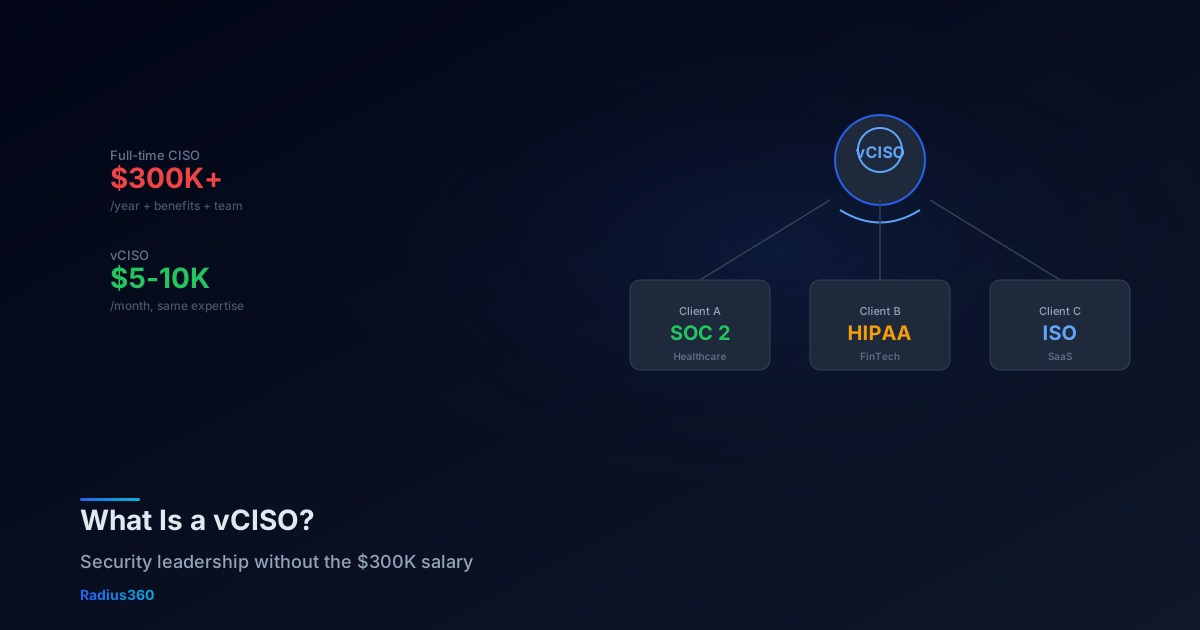
The $300K question
A full-time CISO costs $250,000-$400,000 in salary, plus benefits, equity, and a team to support them. Most companies under 500 employees can't justify that — but they still need someone to own security strategy, manage compliance, and represent the organization to auditors, insurers, and the board.
That's what a vCISO does.
What a vCISO actually does
A virtual CISO (vCISO) is a security leader who works with your organization on a fractional basis — typically 10-40 hours per month. They provide the same strategic guidance as a full-time CISO without the full-time cost.
Core responsibilities:
- Security strategy: Define and maintain the organization's security roadmap, aligned with business goals
- Risk management: Own the risk register, conduct assessments, and prioritize remediation based on business impact
- Compliance management: Drive framework implementation (SOC 2, ISO 27001, HIPAA, NIST CSF), prepare for audits, and manage ongoing compliance
- Board and executive reporting: Translate technical risk into business language for leadership
- Vendor risk management: Assess third-party vendors and manage the security questionnaire process
- Incident response: Lead incident response when events occur, coordinate with legal and communications
- Cyber insurance: Ensure the organization meets carrier requirements and support the underwriting process
- Policy governance: Create and maintain security policies that reflect actual organizational practices
- Team mentoring: Guide internal IT staff on security best practices without replacing them
When you need a vCISO
You probably need a vCISO if:
- Customers are asking for SOC 2 or ISO 27001 and you don't have anyone to own the program
- Your cyber insurance was denied or repriced and the carrier wants to see specific controls
- You're growing into regulated markets (healthcare, finance, government, defense)
- The board or investors want security reporting and nobody's producing it
- You've had an incident and realized nobody owned the response process
- You have IT staff but no security strategy — they're reactive, not proactive
You probably don't need a vCISO (yet) if:
- You're a 5-person startup with no customer data
- You have a full-time CISO already
- Your only security need is "install antivirus"
What to expect from the engagement
Monthly cadence (typical):
- Week 1: Review posture dashboards, triage new risks, check compliance progress
- Week 2: Deep-dive on a specific area (vendor review, policy update, framework gap)
- Week 3: Stakeholder meetings, board prep, insurance coordination
- Week 4: Reporting, roadmap updates, next-month planning
Deliverables you should expect:
- Monthly security posture report with trends
- Quarterly board-ready executive summary
- Updated risk register with ownership and status
- Compliance roadmap with milestone tracking
- Annual security strategy document
- Incident response plan (reviewed annually)
What a vCISO does NOT do:
- Configure your firewall
- Manage your help desk tickets
- Write code or deploy patches
- Replace your IT team
They lead. Your team (or MSP) executes. That division is critical — mixing strategic and operational work is how full-time CISOs burn out.
How to find the right vCISO
Look for:
- Relevant industry experience (healthcare, finance, SaaS, etc.)
- Framework expertise matching your needs (SOC 2, HIPAA, CMMC)
- Clear communication skills — they need to talk to engineers AND board members
- A defined methodology, not just "we'll figure it out"
- A tech stack that enables them to manage multiple clients efficiently
Red flags:
- "We'll handle everything" with no clear scope
- No experience with your industry's frameworks
- Can't explain their process in plain English
- No GRC platform — managing compliance in spreadsheets doesn't scale
How much does a vCISO cost?
| Engagement Level | Hours/Month | Typical Cost | Best For |
|---|---|---|---|
| Advisory | 5-10 | $2,000-$4,000 | Early-stage, one framework |
| Standard | 15-25 | $5,000-$10,000 | Growing company, multi-framework |
| Strategic | 30-40 | $10,000-$20,000 | Complex environment, board reporting |
Compare this to a full-time CISO at $300K+ all-in. For most companies, a vCISO at $5-10K/month delivers 80% of the value at 20% of the cost.
The MSP + vCISO model
Many organizations get the best results by combining an MSP (for IT operations) with a vCISO (for security strategy). The MSP handles day-to-day infrastructure, patching, and monitoring. The vCISO provides the security leadership layer — risk management, compliance, and executive reporting.
BlueRadius operates exactly this model, providing vCISO services that integrate with your existing MSP relationship. The vCISO sets the strategy; your MSP or internal team executes.
For MSPs looking to add security services themselves, see our guide on making the MSP to MSSP transition.
Bottom line
A vCISO is security leadership as a service. You get a named security leader who owns your risk posture, drives your compliance program, and gives your board the confidence that someone competent is watching the store — at a fraction of the cost of hiring full-time.
If you're spending more time reacting to security questions than proactively managing risk, it's time.
Looking for vCISO services? BlueRadius provides fractional CISO leadership for growing companies. Or explore Radius360 — the GRC platform built for vCISOs managing multiple clients.
The vCISO Playbook
Lesson 1 of 10