You're already doing more security than you think
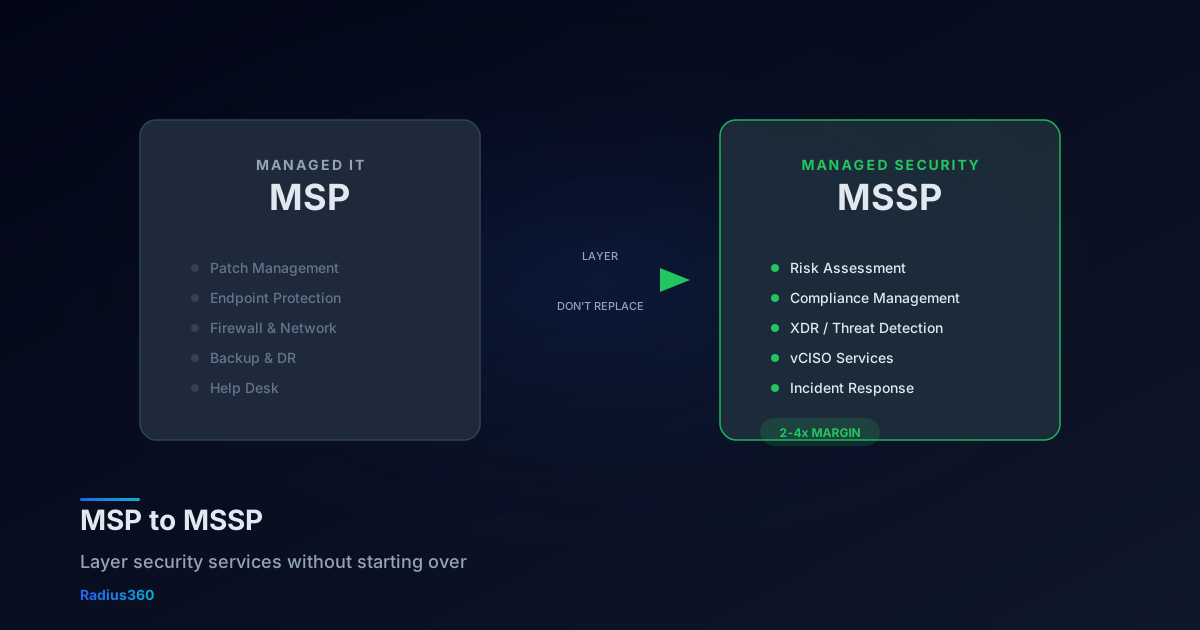
If you're running an MSP in 2026, you're already doing security work. You're patching systems, managing firewalls, deploying endpoint protection, and answering the inevitable "are we secure?" question from clients. The difference between what you do now and what an MSSP does is structure, tooling, and positioning.
The MSP-to-MSSP transition isn't a binary switch. It's a spectrum. And the MSPs winning right now aren't the ones who went all-in on a SOC overnight — they're the ones who layered security services on top of their existing operations, one capability at a time.
Why MSPs are making the move
The math is simple:
- Margins are shrinking on traditional MSP services. Hardware, break-fix, and basic monitoring are commoditized. Clients expect these at lower and lower price points.
- Security is the growth driver. Managed security services command 2-4x the margin of general IT management. A $5K/month IT client becomes a $12-15K/month client when you add security.
- Clients are asking for it. Their cyber insurance carriers require it. Their customers require it. Their boards require it. If you don't offer it, they'll find someone who does.
- Regulatory pressure is increasing. CMMC, state privacy laws, SEC cyber rules, FTC Safeguards — every client in every industry is facing new compliance requirements.
The question isn't whether to add security services. It's how to do it without overextending.
The layered approach: four stages
Stage 1: Package what you already have
You're probably already delivering security value — you just aren't packaging or pricing it as security. Start by formalizing what exists:
What you likely have:
- Endpoint protection (AV/EDR) deployed on managed devices
- Patch management on a schedule
- Firewall management
- Basic backup and disaster recovery
- MFA on key systems
What to do with it:
- Create a "Managed Security Essentials" tier in your service catalog
- Document what's deployed, where, and what's monitored
- Build a monthly security report for clients (even a simple one)
- Price it as a distinct line item, not bundled into "IT support"
This stage costs almost nothing to implement. You're monetizing work you already do by naming it, documenting it, and reporting on it.
Stage 2: Add risk assessment and compliance
This is where you start differentiating from a generic MSP. Your clients need someone to tell them not just "your systems are patched" but "here's your risk posture, here's what's required for compliance, and here's what we're doing about it."
What to add:
- Risk register for each client — even a basic one transforms the conversation
- Compliance framework mapping — SOC 2, HIPAA, NIST CSF, whatever their industry requires
- Quarterly risk assessments with documented findings
- Policy generation — acceptable use, incident response, data handling
How to do it without a compliance team:
- Use a GRC platform that automates framework mapping and evidence collection
- Start with one framework per client (usually the one their insurance or customers require)
- Template your policies — customize per client, don't write from scratch every time
- AI-assisted policy generation can produce 80% of what you need, then you customize for the client's specifics
This is also where BlueRadius works with MSPs — providing the strategic advisory layer (risk assessments, compliance guidance, vCISO expertise) while the MSP handles the technical implementation. You don't need to hire a CISO. You need a partner who can provide that expertise on demand.
Stage 3: Deploy detection and response
This is what most people think of when they hear "MSSP" — actual threat detection and response. But you don't need to build a 24/7 SOC from scratch.
Options (from simplest to most sophisticated):
-
Managed EDR: Deploy CrowdStrike, SentinelOne, or similar with their managed threat hunting. The vendor does the detection — you handle the client communication and remediation.
-
XDR/SIEM-lite: Deploy a platform like Sekoia XDR, Microsoft Sentinel, or Splunk with pre-built detection rules. Alerts flow into your GRC platform and automatically generate risks and mitigation tasks.
-
Co-managed SOC: Partner with a SOC provider who handles 24/7 monitoring. You own the client relationship, they provide the analysts. You escalate, triage, and remediate.
-
Full internal SOC: Hire analysts, build playbooks, run your own detection. Only makes sense at 200+ endpoints or if security is your primary business.
Key principle: Start with option 1 or 2. The XDR-to-risk-register pipeline we described in our evidence collection guide means alerts automatically become documented risks with mitigation tasks — no manual translation needed.
Stage 4: Offer vCISO services
This is the highest-margin layer. Your client gets a named security leader who owns their security strategy, reports to their board, and manages their compliance program.
What a vCISO engagement looks like:
- Monthly security posture review with the client's leadership
- Quarterly board-ready reports (generated from real data, not templates)
- Annual security strategy and roadmap
- Compliance program management across multiple frameworks
- Vendor risk management
- Incident response coordination
- Cyber insurance readiness and renewal support
How to price it:
- Small clients (< 50 employees): $2-4K/month
- Mid-market (50-500): $5-10K/month
- Enterprise (500+): $10-20K/month
These are premium services. A single vCISO can manage 8-12 clients using the right tech stack and platform. The economics are compelling: 10 clients at $5K/month = $600K ARR from one practitioner.
For a deep dive on the vCISO market opportunity, read our State of the vCISO Market in 2026.
The tech stack that makes it work
The MSP-to-MSSP transition fails when you try to do everything manually. Sending reports by email, tracking risks in spreadsheets, and copy-pasting compliance evidence into folders doesn't scale past 3-4 clients.
What you need:
| Capability | Why | What to use |
|---|---|---|
| Multi-tenant GRC platform | Manage risk, compliance, and policies across all clients from one dashboard | Radius360, Drata, Vanta |
| EDR/XDR | Detection and response | CrowdStrike, SentinelOne, Sekoia XDR |
| Identity management | MFA, SSO, access reviews | Okta, Microsoft Entra ID |
| Vulnerability scanning | Continuous vuln assessment | Tenable, Qualys, Rapid7 |
| Security training | Phishing simulation + awareness | KnowBe4, Proofpoint |
| Backup/DR | Immutable backups + tested recovery | Veeam, Datto, Axcient |
The critical piece is the GRC platform. It's the connective tissue that ties everything together — pulling evidence from integrations, mapping it to frameworks, generating risks, creating mitigation tasks, and producing the reports your clients (and their auditors and insurers) need to see.
Common mistakes
Trying to do everything at once. Start with Stage 1-2. Add detection in Stage 3 only when you have the operational maturity to handle alerts without burning out.
Hiring before you have revenue. Don't hire a SOC analyst until you have enough clients to justify it. Use managed services and vendor SOCs until the math works.
Selling tools instead of outcomes. Your client doesn't care that you deployed CrowdStrike. They care that their risk is managed, they'll pass their audit, and their insurance won't be denied.
Ignoring compliance. Detection without compliance is just alert fatigue. Compliance without detection is just paperwork. You need both — and a platform that connects them.
Not partnering. You don't have to know everything. Partner with a vCISO firm like BlueRadius for strategic advisory, a SOC provider for 24/7 monitoring, and a GRC platform for the operational backbone. The MSPs that scale fastest are the ones who build partnerships instead of trying to do it all in-house.
The bottom line
The MSP-to-MSSP transition is happening whether you drive it or not. Your clients are being forced into better security by insurers, regulators, and their own customers. The MSPs that layer security services — starting with what they already have and building up — will capture the margin. The ones that wait will watch their clients leave for providers who offer what they need.
Start with Stage 1 today: name your security services, document what you deliver, and report on it monthly. You'll be surprised how much value you're already providing — and how much more you can charge for it.
Building a security practice? BlueRadius helps MSPs design and deliver managed security and vCISO services — from go-to-market strategy to technical implementation. Pair it with Radius360 for the multi-tenant GRC platform that scales with your client base.
The vCISO Playbook
Lesson 9 of 10