The 2026 cyber insurance renewal market, in one sentence
If you renewed in 2022, your premium probably doubled and your coverage shrank. If you renew in 2026, the story is flipped: the market has stabilized, new capacity is back, and the underwriters I've talked to this year say the same thing in different words — they want to see your security program, not your promises.
This is the renewal playbook for the 2026 cycle. What they'll actually ask. What evidence they want. What causes premium hikes. What causes non-renewals. Written from the perspective of a CISO who's been on both sides of the table: filling out the questionnaire and reviewing the ones my clients submit.
If you're earlier in the process and need context on general coverage requirements rather than renewal specifically, start with 2026 cyber insurance requirements — this post picks up where that one leaves off.
Three things your underwriter will ask this year
Every cyber insurance questionnaire looks slightly different, but the 2026 cycle has converged on three non-negotiables. If you can't demonstrate these cleanly, the conversation isn't going where you want.
1. MFA on everything that touches email or remote access. Not "most systems." Every user, every vendor, every privileged account, every machine-to-machine integration. If you still have legacy SMTP relays with password auth or service accounts with static keys, underwriters now treat that as material risk. The right answer is "100% MFA coverage, SSO-enforced, conditional-access policies documented." The wrong answer is "almost all of our systems."
2. Functional EDR with 24/7 monitoring. "We have CrowdStrike" is no longer the answer. They want to know: deployed to what percentage of endpoints, monitored by whom, with what alerting SLA. "Installed on most of our Windows fleet and monitored business-hours by our IT team" is a premium-hike signal. "100% coverage on production endpoints, 24/7 MDR via [provider], documented runbook" is what gets the good rate.
3. Immutable, tested backups. The 2023–2024 ransomware wave taught carriers that "we have backups" means nothing if the backups were encrypted along with production. They want backups stored off-network (immutable cloud tier, separate account, or air-gapped), and they want evidence you've tested a restore in the last 12 months. The restore test is the one most companies fail to produce.
The technical controls audit goes deeper in 2026
Beyond the big three, here's what the 2026 questionnaire surfaces that earlier versions didn't:
- Email security posture. DMARC, SPF, DKIM deployed in enforcement mode — not just p=none monitoring. Phishing simulation cadence and catch rate over the last 12 months. Specific anti-BEC controls (Abnormal, Proofpoint threat intelligence, or equivalent).
- Patch SLAs with evidence. Not "our policy says 30 days" — actual data from your vulnerability management tool showing average time-to-remediate and current backlog of critical/high CVEs older than SLA.
- Access review cadence. When did you last review access for [major system]? Carriers want quarterly minimum, with evidence the review actually happened and changes were applied.
- Privileged access management. Is there a PAM solution? If yes, which one and covering what. If no, how are admin credentials managed — and "in a shared password manager" is the wrong answer.
- Incident response readiness. Tabletop exercise in the last 12 months? Documented runbook with roles and escalation? 24/7 IR retainer in place?
- Third-party/vendor risk. Do you have a TPRM program? How do you assess critical vendors? Are BAAs and DPAs in place for data processors? (If this is a gap, see how to build vendor risk from scratch.)
The evidence packet that shortens the conversation
The difference between a four-hour back-and-forth and a 30-minute approval call is usually the evidence packet you bring. What goes in a good one:
- System inventory — asset list with criticality tier and control coverage (MFA, EDR, backup, patch status per asset)
- Access review report — most recent quarterly review with number of revocations and changes applied
- Patch status snapshot — critical and high CVEs older than your stated SLA, with remediation status
- Phishing program results — last 12 months of click rates, report rates, and repeat-clicker trends
- EDR coverage report — agent deployment percentage by OS, alerting volume summary, escalation SLAs
- Backup test evidence — most recent restore test: date, what was restored, validation result
- SOC 2 / ISO 27001 report if applicable — executive summary is fine, full report on request
- Incident response plan — current runbook with team, roles, and escalation paths
- Third-party risk register — top 20 vendors with assessment status and BAA/DPA state
Most companies bring two or three of these. Bringing eight or nine visibly changes the tone of the meeting — your broker stops defending you and starts selling you.
What causes a premium hike in 2026
From conversations with brokers this cycle, the patterns are consistent:
- MFA gaps. Any meaningful MFA gap (a legacy system, a service account, SSO-bypass configured "for convenience") triggers a premium hike. This is the number-one trigger in 2026.
- Ransomware in the last 3 years, even fully recovered. Your premium reflects the event for the full 3-year lookback window regardless of how well you handled it. Nothing to do except wait it out.
- No EDR on server workloads. Endpoint-only EDR is a gap. Linux servers need EDR too, and "we rely on network controls for our servers" is not the answer carriers want.
- Single-cloud backup without immutability. If backups live in the same AWS account as production, you're one IAM misconfiguration away from losing them with production. Carriers know this and price it.
- Executive-level turnover in IT or Security without succession. Brokers tell me this one doesn't show up in the questionnaire but comes up in the underwriter call. If your CISO left and hasn't been replaced, you're paying a premium.
When carriers decline — three patterns I see
Non-renewals and declinations are rarer in 2026 than 2022 but still happen. The patterns:
1. Unresolved ransomware event. An incident in the last 12 months without a documented root-cause analysis, remediation plan, and post-incident review. Carriers can't underwrite ongoing unresolved risk.
2. Regulated data with controls significantly below regulatory baseline. Healthcare provider with no HIPAA Security Rule assessment. PCI-scoped merchant with no documented scope boundary. Defense contractor with no CMMC readiness plan. The mismatch between regulatory obligation and actual posture creates bad coverage math.
3. Persistent low-quality questionnaire responses. Three renewals of vague answers, missing evidence, or contradictions between the questionnaire and what the broker's own research surfaces. When carriers feel they can't trust the information, they decline rather than attempt to price the uncertainty.
Four steps to prep for renewal 60 days out
If your renewal is in the next two months, this is the prep sequence that actually works:
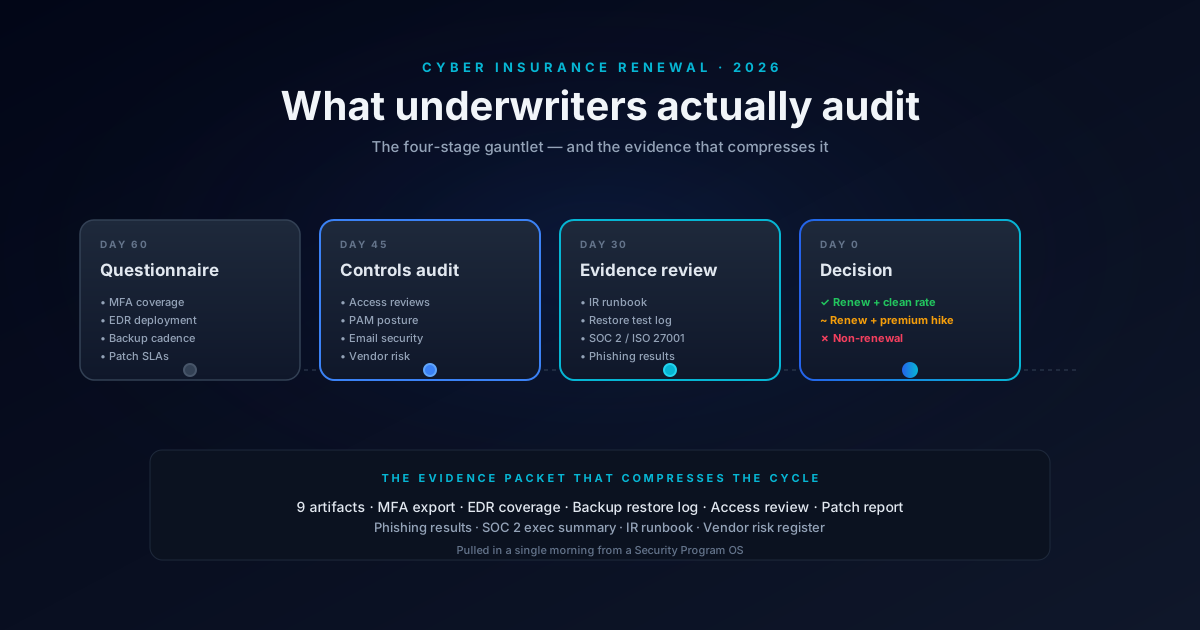
Day 60–45: Evidence gathering. Pull the nine artifacts listed above. If any don't exist, either generate them or note their absence explicitly — you can't hide missing evidence during the audit phase.
Day 45–30: Gap remediation. Fix the fixable. Add MFA to the two legacy systems. Patch the critical CVEs older than SLA. Run the backup restore test if you haven't in 12 months. Don't try to remediate everything — triage to what the questionnaire actually asks.
Day 30–15: Questionnaire draft. Complete the questionnaire with your broker. For any partial or in-progress answer, include a one-sentence remediation plan with a date. Vague answers lose you premium points; specific "we're at 87% MFA coverage, completing the remaining 13% by [date] via [approach]" answers often earn you credit.
Day 15–0: Evidence packet + broker pre-sell. Compile the evidence packet. Share it with your broker before the underwriter call so they can pre-sell the underwriter. Be ready to walk through it live in the meeting.
The 2-hour evidence package you can build today
If your renewal isn't imminent, you can still get ahead. Here's a two-hour exercise that turns next year's renewal from a scramble into a formality:
- 30 min — MFA coverage export. Pull from your IdP (Okta, Azure AD, Google Workspace). Calculate percentage of active users with MFA enabled. List the accounts and systems without it, with a remediation owner and date.
- 30 min — EDR coverage report. Pull agent deployment from your endpoint tool. Break out by OS. Note any endpoints without an agent and why.
- 30 min — Backup restore test. Run a live restore on your most critical system. Document what you restored, how long it took, and whether data validated. This single artifact closes half of the renewal concerns carriers have.
- 30 min — Access review sign-off. Review and formally sign off on last quarter's access review. If you don't have one documented, start a simple spreadsheet today: system, owner, last reviewed date, action taken. This document shrinks 40% of renewal-questionnaire friction.
That's your renewal kit in a single morning. Refresh it quarterly and the next cycle becomes a 30-minute call instead of a multi-week ordeal.
Where Radius360 fits in the renewal prep
Radius360 isn't cyber insurance. It's the Security Program OS that produces the evidence cyber insurance underwriters want — the same MFA coverage report, the same backup test logs, the same access review artifacts. If you're using Radius360, the 2-hour evidence kit above is a series of exports from one platform, not a morning of scrambling across five tools and three spreadsheets.
For small security programs and vCISO practices renewing multiple clients' cyber insurance simultaneously, this compounds. One platform produces one evidence package pattern. Your broker starts expecting the same artifacts from every client you send them. Over time the renewal cycle compresses from weeks to days — and the quality of the underwriter conversation shifts from "prove you have controls" to "here's our posture, what's the cleanest rate you can offer."
The 2026 cycle is more forgiving than 2022. But it's still a real audit, and the companies that treat it as "here's the 9-artifact evidence packet you'll ask for" get meaningfully better terms than the ones that treat it as "here's our questionnaire response, hope that's enough."
Questions about renewal prep or the evidence artifacts? support@radius360.co — I read every one.
See how Radius360 helps
Put these ideas into practice with the right tooling.
See how Radius360 generates the evidence packet