The AI agent gold rush
If you've been on LinkedIn this month, you've seen the announcements. Every GRC and vCISO platform is suddenly launching "AI agents," "co-worker agents," or "CISO intelligence." The marketing follows a familiar pattern: smart-sounding capabilities, vague descriptions of what the agent actually does, and pricing that conveniently rises to match.
The pitch sounds compelling. The reality is mostly chat interfaces wrapped around existing data, with a few automated summaries thrown in. That's not an agent. That's a search bar.
A real AI agent for a vCISO does three things:
- Detects what changed — surfaces the things that need attention without being asked
- Explains why it matters — connects technical findings to business impact
- Takes action — actually fixes things, or queues them up for fixing, in one click
Most platforms are good at #1 (dashboards). Some are okay at #2 (AI summaries). Almost none deliver #3.
What "AI agent" should actually mean
Here's the test: when an XDR alert fires at 2 a.m., what does your platform do?
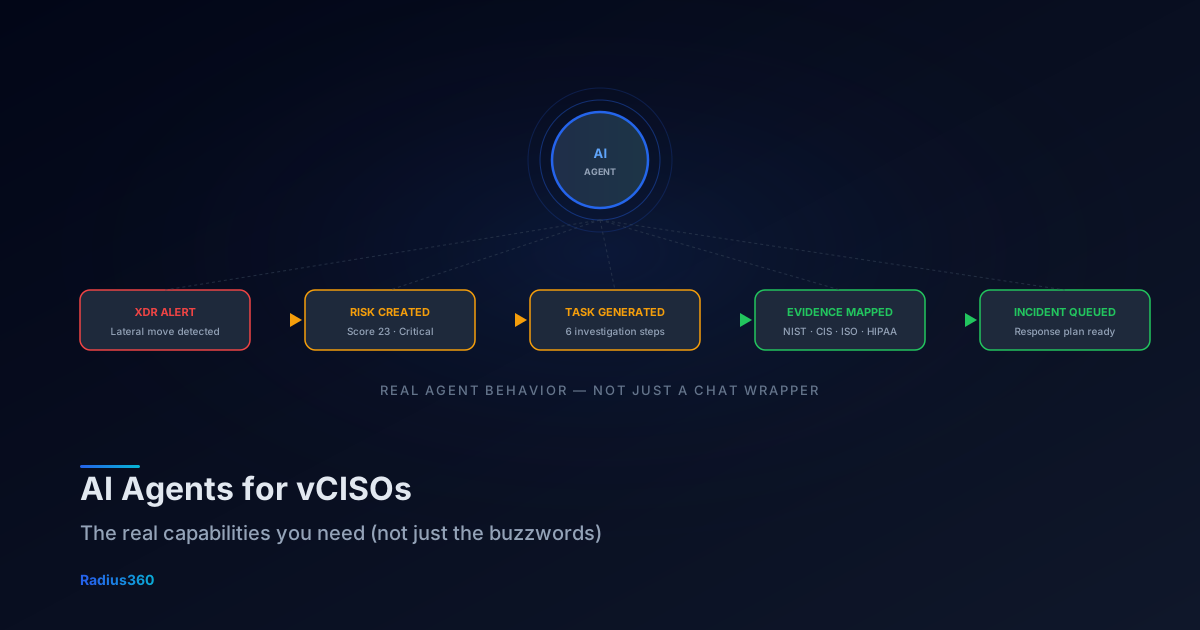
Bad: Sends an email saying "alert fired." Better: Creates an incident with the alert details. Real agent: Creates a risk in the register with source IPs, target hosts, and MITRE ATT&CK techniques. Generates a contextual investigation task with step-by-step remediation. Maps the finding to NIST CSF, ISO 27001, CIS, CMMC, and HIPAA controls. Updates the framework evidence vault. Auto-escalates to an incident if severity warrants. Notifies the vCISO with everything they need to act in a single view.
That's what we built into Radius360 for our Sekoia XDR integration — and the same pattern applies to CrowdStrike, SentinelOne, Microsoft Sentinel, AWS Security Hub, Tenable, and 7+ other deep integrations. Every alert flows through the same pipeline. Every finding becomes a tracked, mapped, actionable item. No manual triage. No copy-paste between tools.
The capabilities checklist
If you're evaluating AI in a vCISO platform, ignore the marketing copy and ask these questions:
1. Does it auto-generate risks from real telemetry?
Not "you can ask AI about your risks." Not "AI summarizes your dashboard." Auto-generation means the platform watches your integrations and creates risk register entries when something appears. The risks should have:
- A clear title that names the problem ("Lateral move detected — ws-sales-01 from 10.0.7.8")
- Source attribution (which integration, which alert ID)
- MITRE ATT&CK or CVE references
- Impact and likelihood scoring
- A linked mitigation task
2. Does it create investigation tasks automatically?
When a high-severity finding appears, the platform should generate a task with:
- The investigation steps (triage, contain, investigate, remediate, document)
- Suggested response actions specific to the threat type
- A linked risk in the register
- Priority based on urgency, not just a generic "high"
- Auto-cleanup when the source finding is resolved
3. Does it map findings to compliance controls?
A real agent understands that one alert affects multiple frameworks. A lateral movement detection touches NIST DE.AE, RS.AN, CIS 17.4, ISO 27001 6.1.5, and HIPAA 164.308(a)(6)(ii). The platform should write evidence to all of them — not just one — and let you point at the audit trail when the auditor asks "how do you detect intrusions?"
4. Does it act on insights, not just display them?
This is the test that separates real automation from dashboard porn. When the platform tells you "5 high-severity risks have no mitigation plan," there should be a button that fixes it. One click. AI generates the mitigation tasks based on the risk context. You review and adjust if needed.
In Radius360, this same pattern applies to:
- Stale evidence (>90 days) → button to re-sync from source integrations
- Draft policies stuck in review → button to bulk-move to review
- Low framework completion → button to run AI gap assessment
- Untasked high risks → button to AI-generate mitigation plans
Each button calls a real edge function and updates the database. The insight disappears when the work is done. That's the difference between an AI that talks and an AI that works.
5. Does it show you what it's been doing?
You should be able to look at a feed and see: "5 risks auto-generated from CrowdStrike. 12 evidence items collected from M365. 1 incident escalated from Sentinel. Daily posture snapshot calculated."
This matters because vCISOs need to explain to clients what their platform is doing for them. "Look, here's a week of automated security work" is a more compelling sales conversation than "I have a tool I check sometimes."
6. Does it understand context?
A risk score of 23 with the title "Critical Security Event" is useless. A risk titled "Lateral move detected — 10.0.1.51 from 198.51.100.33 (urgency 90/100, MITRE T1021)" tells you what happened, where, how serious, and which adversary technique was used. AI should enrich findings, not just dashboard them.
What to look for in a demo
Most vCISO platform demos go like this: "Here's our AI assistant. Ask it anything about your security posture." That's a chat wrapper. Ask the salesperson to demonstrate the following instead:
- Show me an XDR alert flowing in real-time and creating a risk, task, and incident automatically
- Show me the same alert mapped to controls in 3 different compliance frameworks
- Show me the dashboard insight that says "X needs attention" and the button that fixes it
- Show me the activity feed of what the platform did this week without anyone asking
- Show me how a high-severity risk gets auto-cleaned up when the source finding is resolved
If they can't do all five, they have a chat wrapper. They don't have an agent.
The unfair question
The platforms launching "AI agents" this quarter are mostly enterprise GRC tools or generic vCISO platforms that bolted AI on top. They have marketing budget, brand recognition, and a head start. But they don't have the architectural advantage that comes from building automation into the data model from day one.
Radius360 was built from the start around the principle that integrations should generate risks, risks should generate tasks, tasks should map to evidence, and evidence should prove control coverage. The AI agent isn't a feature we added — it's how the platform works.
If you're evaluating vCISO platforms and want to see real agent behavior instead of marketing copy, start a free trial or book a demo. We'll show you the alert-to-evidence pipeline live, with real data from your own environment.
Bottom line
AI agents are the future of vCISO platforms. But only if "agent" means something more than "chat that knows your data."
The capabilities that matter:
- Auto-generation of risks, tasks, and incidents from real telemetry
- One-click fix actions on insights
- Contextual investigation guidance
- Multi-framework control mapping
- Visible activity feed of automated work
- Stale finding cleanup
If your current platform doesn't do these things, the latest "AI agent" announcement won't fix it. The bottleneck isn't the AI — it's the architecture underneath.
Want to see what a real vCISO AI agent looks like? Start a free trial of Radius360 — no credit card required. Or talk to BlueRadius about how to evaluate AI capabilities in your next platform.
